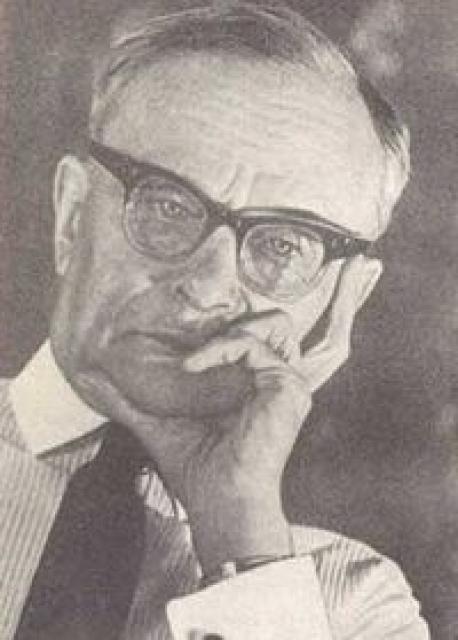
Vladimir Vladko
 Ukraine
Vladimir Nikolayevich Vladko
Vladimir Nikolayevich Vladko, born Vladimir Nikolayevich Yerechenko on December 26, 1900 (January 8, 1901) in Saint Petersburg, was a Ukrainian Soviet journalist and science fiction writer. He is widely recognized as the founder of Ukrainian science fiction.
Vladko graduated from the Voronezh Institute of Public Education in 1921 and embarked on a career in journalism. In 1941, he served as a political commentator for the Ukrainian radio station named after T. G. Shevchenko in Saratov, and also worked as a special correspondent for the Soviet Information Bureau (Sovinformburo).
In 1943, Vladko became a correspondent for the newspaper "Pravda" in the Kharkiv Oblast. In 1944, he joined the ranks of the Communist Party of the Soviet Union (CPSU). His journalistic career culminated in 1947 when he became the Head of the Main Repertoire Committee of the Ukrainian SSR (USSR). In 1951, he was appointed Editor-in-Chief of the "Literary Gazette" in Kyiv.
Vladko's literary contributions played a pivotal role in the development of Ukrainian science fiction. He published his first novel, "Robots on the March," in 1929. This was followed by the novel "Argonauts of the Universe" in 1935 and the short story collection "Twelve Stories" in 1936. Vladko's works explored themes of scientific progress, societal transformation, and the human condition.
Vladko's literary output continued throughout his career. Notable works include the novels "Descendants of the Scythians" (1939), "Gray Captain" (1941), "Borrowed Time" (1961), "Iron Rebellion" (1967), and the novella "Violet Death" (1965). His writings made a significant impact on Ukrainian literature, inspiring generations of science fiction writers and readers. Vladko passed away on April 21, 1974, leaving behind a rich literary legacy that continues to be celebrated and studied today.