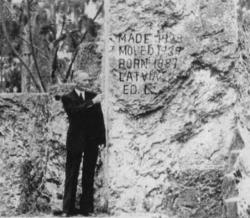
Walter De Maria
 USA
USA- Early Life and Education
- Move to New York and Artistic Beginnings
- Minimalism and Industrial Materials
- Conceptual and Fluxus Influences
- Land Art and Earthworks
- Documenta and International Recognition
- Continued Exploration of Land Art and Geometric Forms
Early Life and Education
Walter De Maria was born on October 1, 1935, in Albany, California. From 1953 to 1959, he attended the University of California, Berkeley, majoring in history and art.
Move to New York and Artistic Beginnings
In 1960, De Maria moved to New York City, where he wrote essays on art published in "Young's Anthology" in 1963. His first wooden sculpture was created in 1961. Together with Robert Whitman, he founded the 9 Great Jones Street gallery in 1963, where De Maria's first solo sculpture exhibition was held that same year.
Minimalism and Industrial Materials
Influenced by Dadaism and other modernist movements, De Maria's early sculptures in the 1960s incorporated simple geometric forms and industrial materials such as steel and aluminum, characteristic of Minimalism. In 1965, he received support from collector Robert C. Scull for these works.
Conceptual and Fluxus Influences
De Maria was involved in various projects in the mid-1960s, including the "Cage" for John Cage, which was part of the iconic "Primary Structures" exhibition (1966). He also participated in happenings, composed musical pieces, and made films. His work explored conceptual and Fluxus influences.
Land Art and Earthworks
From 1968 onwards, De Maria focused on minimalist sculptures and installations such as "Munich Erdraum" (1968). He also realized land art projects in the desert of the southwestern United States, seeking to create experiences where landscape, nature, light, and weather became immersive physical and psychological encounters. "Mile Long Drawing" (1968) featured two parallel chalk lines in the Mojave Desert.
Documenta and International Recognition
De Maria emerged as one of the leading figures in Land Art in 1968 when he filled the Heiner Friedrich Gallery in Munich with dirt. He also participated in Documenta in Kassel that year. A major exhibition of De Maria's sculptures was held at the Kunstmuseum Basel in 1972.
Continued Exploration of Land Art and Geometric Forms
Land art and serial geometric sculptures continued to dominate De Maria's work in the 1970s, including projects such as "Three Continent Project" (1972) and "Lightning Field" (1977). In 1977, he recreated the "Earth Room" at the Heiner Friedrich Gallery in New York City.