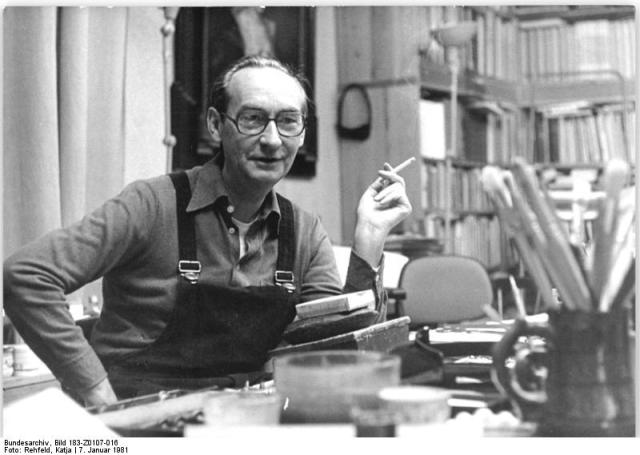
Werner Klemke
 Germany
- Early Life and Influences
- Art and War
- Post-War Breakthrough
- Book Illustrations and Critical Acclaim
- Teaching and International Renown
- Administrative Duties and Artistic Struggle
- Retirement and Legacy
- Artistic Diversity and Awards
Early Life and Influences
Werner Klemke, born in Berlin in 1917, was raised with an inquisitive mind. His passion for drawing, visits to libraries, and love for excursions ignited his interest in classical art and literature, which later fueled his own artistic endeavors.
Art and War
In the late 1930s, Klemke worked as a drawing teacher but left due to low wages and lack of artistic fulfillment. In 1937, he joined the animation studio 'Kruse-Film'. During World War II, he served in the military, where he courageously forged documents to save Dutch Jews from persecution.
Post-War Breakthrough
After the war, Klemke discovered lithography in an internment camp in Ostfriesland. This revelation led to his first illustrated children's book, 'Die Bremer Stadtmusikanten', in 1945.
Book Illustrations and Critical Acclaim
Returning to Berlin, Klemke faced financial difficulties. He worked as a window dresser, mural painter, and ceramic designer. In 1947, he began illustrating for publishers, including Neue Berliner Illustrierte and Der Junge Pionier. His breakthrough came with a commission to illustrate Georg Weerth's 'Humoristischen Skizzen aus dem deutschen Handelsleben'. His exceptional woodcuts earned him recognition as one of the finest engravers of the 20th century.
Teaching and International Renown
Klemke's success led to a professorship at the Hochschule für Bildende und Angewandte Kunst in Berlin. His study of engraving in China in the mid-1950s profoundly influenced his subsequent artistic output.
Administrative Duties and Artistic Struggle
In 1961, Klemke became a member of the Academy of Arts of the GDR, and in 1964, he headed its Department of Visual Arts. This administrative work took a toll on his creativity, causing inner turmoil and depression.
Retirement and Legacy
Klemke retired in 1982. After suffering a stroke in 1986 and losing his wife in 1988, he experienced another stroke that severely limited his physical and artistic abilities. He passed away in 1994 and was buried at St.-Hedwigs-Friedhof in Berlin.
Artistic Diversity and Awards
Klemke's oeuvre encompassed a wide range of mediums, including newspaper and magazine illustrations, stamps, stained glass windows, posters, brochures, medals, engravings, record sleeves, playing cards, and more. He resisted specialization, seeking to explore the full extent of his talent.
Among his numerous awards were the National Prize of the GDR (three times), the Order of Merit for the Fatherland, and honorary memberships in the Academy of Arts of the USSR and the Italian city of Certaldo for his illustrations of 'Decameron'.


