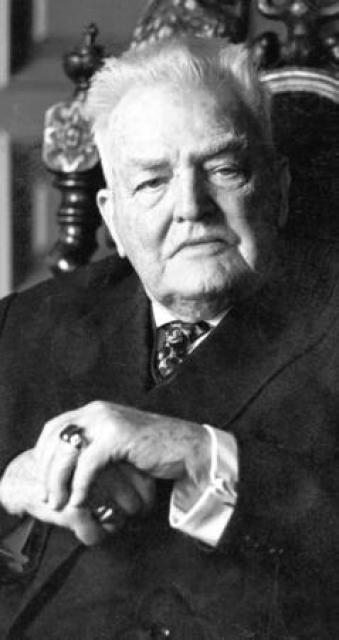
Wilhelm von Scholtz
 Germany
Biography of Wilhelm von Scholz
Wilhelm von Scholz was a German poet and writer, born on July 15, 1874, in Berlin. He came from a prominent family, with his father Adolf von Scholz being the last finance minister of Bismarck's government. Wilhelm studied the history of literature, philosophy, and psychology in Berlin, Lausanne, and Kiel. In 1897, he defended his dissertation on Annette von Droste-Hülshoff in Munich and then moved to Weimar to pursue a career in literature.
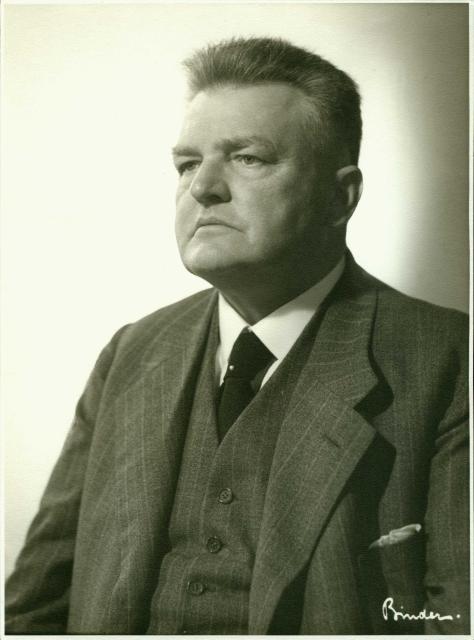
During World War I, Scholz served as an army officer, and from 1916 to 1922, he held the position of the first playwright and director at the court theater in Stuttgart. In 1926, he was elected chairman of the poetry section of the Prussian Academy of Arts. After his resignation, he settled in the estate of Seehaim near Konstanz, where he lived until his death. Wilhelm von Scholz passed away on May 29, 1969.

Literary Career
Scholz made his debut in literature with poems influenced by Rilke and Lilienkron, such as "Spring Trip" in 1896. However, he soon turned to depict mystical and occult experiences that he had encountered on the brink of life and death. His first poetry collection, "Mirror," was published in Berlin in 1902 and featured incessant repetitions of the words "darkness" and "shadow" as if incantations. Inspired by the works of Paul Ernst and Christian Friedrich Hebbel, Scholz also turned to neoclassicism, a movement that sought to revive the traditions of German classicism.
In his plays, characterized by precise historical details and form, Scholz focused on the values of authoritarian German society during the time of Wilhelm. He shied away from language and formal experiments. His play, "The Jew from Constance," published in 1905, gained him success as it depicted the tragic fate of a Jew who converted to Christianity in the Middle Ages. His tragedy "Race with Shadows" (1920), which portrayed the encounter between a writer and the protagonist of his last work, gained recognition beyond Germany.
In his novel, "Perpetua" (1926), which achieved significant popularity, the protagonist, gifted with the ability to perform magic, sacrifices her life to save her sister from being burned at the stake. During the Nazi era, Scholz compiled anthologies, adapted literature, and wrote autobiographical books and poems that glorified Adolf Hitler and National Socialism. In his memoir "On the Ilm and Isar" (1939), he expressed explicitly anti-Semitic statements, apologizing for his previous views on Jewish dominance in science, art, and social life.
Metaphysical Exploration in Scholz's Works
Scholz's extensive literary legacy includes ballads, traditional-style poems, as well as mystical and fantastical stories compiled in two collections: "Unreal" (1916) and "Intermediate Realm" (1922). His stories revolve around mysterious and supernatural phenomena, aiming to evoke interest in the mysteries of the soul and transcendental states of consciousness. Scholz seeks to find higher metaphysical meanings in the unexplainable, presenting chance occurrences as fateful events.
Scholz's exploration of metaphysical experiences, surpassing even that of Paul Ernst, another neoclassicism follower, is evident in his interest in paranormal and occult phenomena. However, he does not attempt to comprehend the supernatural but rather describes it, unable to break free from earthly confines. His works do not provide any interpretations of the occult phenomena, whether rational or irrational. Instead, they involve speculative reflections.
Scholz's stories distinguish themselves from typical horror tales that are quickly forgotten once the book is closed. They feature a unique psychological depth and traditional narrative style. For instance, in the collection "Unreal," Scholz focuses on extreme psychological states. The collection also includes a humorous story about "the art of soul transmigration," where a sorcerer and demons inhabit the bodies of the dead, causing a great commotion.
Within the collection "Intermediate Realm," spirits and ghosts hold a central place. The story "Head in the Window," belonging to the genre of ghost stories, narrates the mystical telepathic relationship between two strangers. The story unfolds when a German artist living on the outskirts of Rome vaguely discerns the silhouette of a bearded man ahead of him one night. Suddenly, the man turns into an alley. That same night, the artist decides to depict a scene of two men attacking a lone traveler on his canvas. The artist awakens from a troubled dream in the middle of the night. His dog indicates that outside the window (which cannot be reached from the outside), a bloodied head silently pleads for help. The face of the head is distorted by fear, and then it seems to disintegrate. The artist searches around the house but finds nothing unusual. Despite his dog's eagerness to go outside, the frightened artist hesitates to leave his shelter, believing the vision to be a result of overexcitement and bad dreams. In the morning, he adds the head from the nocturnal vision, etched into his memory, to the body of the victim on his painting. Soon after, he accidentally learns that two robbers killed a stranger in the alley on the same night he had the vision. The stranger turned out to be an eccentric shepherd endowed with the gift of foresight. He had foreseen the robbers' intention to attack the artist and saved his life by confusing them. The nocturnal vision was his cry for help, which the artist failed to understand. Attempts to give the incident a rational explanation, referring to coincidences, the shepherd's clairvoyance, or the artist's imagination, which triggered the scene on the canvas foreseeing the events, do not work since dogs have no imagination or dreams. The dog's behavior indicates the reality of the event, and it understands its meaning better than its owner.
Similar themes are explored in the story "Warning," where four gentlemen, assumed to be deceased, sit next to two passengers traveling in a compartment of a fast train. Following an internal impulse, the passengers decide to leave the train at the next station, and shortly after their departure, the train crashes in a tunnel.
In the story "Portrait," Scholz delves into the mystical and supernatural bond between separated lovers. The ghost of the lover's departed beloved emerges from her portrait, manifesting an enduring passion.
In "Closeness," another ghost story, the protagonist senses the presence of a deceased woman who constantly interferes with his relationships with other women. Only the discovery of his deceased mother's portrait, memories of whom his father had tried to erase, resolves the conflict by materializing the unknown. This materialization breaks the subconscious connection between the protagonist and his mother, who had opposed every new chosen one until she received recognition herself.
Wilhelm von Scholz's stories, with their unveiling of hidden metaphysical connections, distinguish themselves from ordinary horror tales and leave a lasting impression. It is regrettable that his works are largely forgotten today. Apart from the mentioned story collections, his anthology of essays, "Nothing but Coincidences" (1960), features his most famous essay, "Coincidence," written in 1924. Scholz's literary oeuvre bears similarities to the works of Karen Blixen, a Danish author.