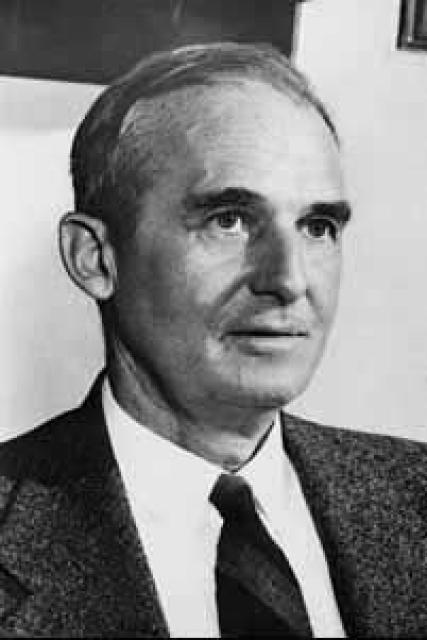
William Giauque
 USA
USA- Early Life and Education
- Academic Career at Berkeley
- Thermodynamics and Low Temperatures
- Third Law of Thermodynamics
- Adiabatic Demagnetization
- Nobel Prize in Chemistry
- Other Discoveries and Contributions
- Wartime Contributions and Post-Nobel Career
- Personal Life and Legacy
Early Life and Education
William Francis Giauque, an American physical chemist, was born in Niagara Falls, Ontario, Canada, in 1895. His parents, William Tecumseh Sherman Giauque and Isabella Jane Giauque (née Duncan), had emigrated from the United States. After living in Michigan until 1908, the family returned to Canada following the elder Giauque's death.
Giauque attended Niagara Falls Collegiate Institute before working at Hooker Electrochemical Company in Niagara Falls for two years. He then pursued a degree in chemical engineering at the University of California, Berkeley, graduating with honors in 1920.
Academic Career at Berkeley
After graduating, Giauque remained at Berkeley, initially as an assistant professor in 1927, then as an associate professor in 1930, a full professor in 1934, and finally, as an emeritus professor in 1962. His research primarily focused on thermodynamics and the behavior of matter at extremely low temperatures.
Thermodynamics and Low Temperatures
Thermodynamics deals with the properties of systems in equilibrium and the conversion of heat into mechanical, chemical, and electrical energy. The first law of thermodynamics states that energy cannot be created or destroyed but only transferred or converted. The second law predicts whether chemical reactions or physical processes will proceed spontaneously.
Third Law of Thermodynamics
Giauque's research was particularly influential in understanding the third law of thermodynamics, proposed by Walther Nernst. It states that the entropy of a pure crystalline chemical element is zero at absolute zero (0 K). Under these conditions, molecules are perfectly organized, and no spontaneous changes occur.
Adiabatic Demagnetization
In 1924, Giauque proposed a method to achieve even lower temperatures based on the phenomenon known as adiabatic demagnetization. It involves using substances called paramagnetic salts, which contain magnetic dipoles due to unpaired electrons. When placed in a strong magnetic field, these dipoles align, lowering entropy. Conversely, cooling can also occur when the field is removed.
Nobel Prize in Chemistry
Giauque's groundbreaking work earned him the Nobel Prize in Chemistry in 1949 for "his contributions to chemical thermodynamics, particularly concerning the behavior of substances at extremely low temperatures."
Other Discoveries and Contributions
Giauque and his colleagues also discovered two previously unknown isotopes of oxygen, oxygen-17 and -18. He confirmed Werner Heisenberg's theoretical prediction about the existence of two forms of hydrogen molecules.
Wartime Contributions and Post-Nobel Career
During World War II, Giauque contributed to military programs by designing high-field electromagnets and mobile units for producing liquid oxygen. After the war, he continued his research at Berkeley until shortly before his passing in 1982.
Personal Life and Legacy
Giauque married Muriel Frances Ashley, a physicist specializing in botany, in 1932. They had two sons. Giauque's legacy includes numerous awards and honors, including the Willard Gibbs and Gilbert Newton Lewis Medals from the American Chemical Society.


