Wright brothers
 USA
USA- The Wright Brothers: Pioneers of Aviation
- Early Years and Interest in Flight
- From Publishing to Bicycle Manufacturing
- The First Controlled Flight
- Advancements and Patents
- Success and Legacy
The Wright Brothers: Pioneers of Aviation
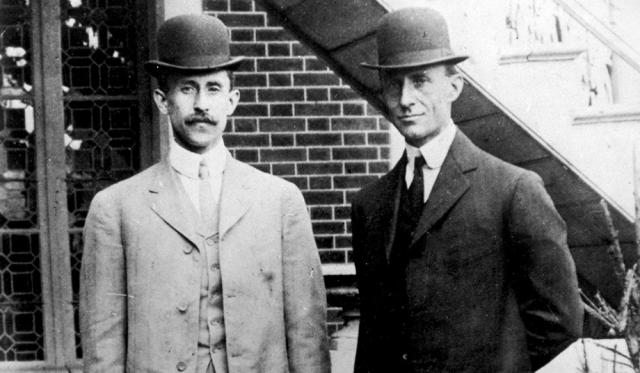
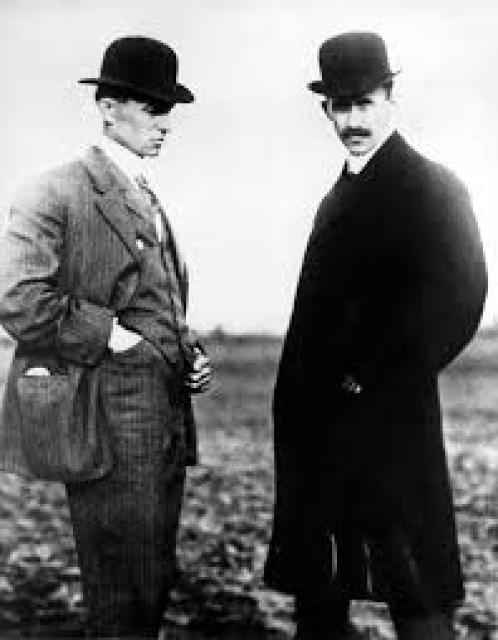
Orville and Wilbur Wright were two American brothers who are recognized worldwide for their groundbreaking invention and construction of the world's first airplane. Born on August 19, 1871, in Dayton, Ohio, Orville Wright and April 16, 1867, in Millville, Indiana, Wilbur Wright were two of the seven children of Milton Wright, an Episcopal bishop with English and Dutch roots, and Susan Catherine Koerner, of German-Swiss descent. The Wright brothers never married.
Early Years and Interest in Flight
In 1878, their father bought them a toy helicopter based on the design by French inventor Alphonse Penaud. The toy, made of paper and bamboo, was about 30 cm long and powered by a rubber band. Orville and Wilbur became fascinated with flight thanks to this toy. They quickly built a similar contraption after breaking the original. Although they attended school, neither of the Wright brothers obtained diplomas.

From Publishing to Bicycle Manufacturing
Wilbur dropped out of school and became involved in the publishing business, where he designed a printing press with Orville's assistance. However, their venture was short-lived, and they shifted their focus to bicycle manufacturing in 1892. Within four years, the Wright brothers started producing bicycles under their own brand, using the proceeds to finance their aviation experiments. After studying the works of George Cayley, Otto Lilienthal, Leonardo da Vinci, and others, the Wright brothers were unstoppable.
The First Controlled Flight
Based on their observations, Wilbur concluded that birds changed the angle of their wingtips during flight, allowing them to turn left and right. The Wright brothers decided to incorporate this "wing warping" technique and conducted several glider flights in the autumn of 1900. Although most of the launches were unmanned, Wilbur eventually dared to participate in a few free flights, completing over a dozen successful flights. The first experiments were deemed successful.
Advancements and Patents
In the following years, Orville and Wilbur continued their aviation experiments, incorporating different wing shapes and calculating lift. In 1902, they launched a glider with a modified wind tunnel and other improvements. Eventually, the Wright brothers achieved control of the aircraft along three axes: pitch, roll, and yaw. In March 1903, they filed a patent for their invention. The following year, they added an engine to the Flyer-1. After facing disappointments with Flyer-2, they took a break from flying in 1906 and 1907. In 1908, they made improvements to the Flyer-3 and signed a contract with the US Army.
Success and Legacy
On May 14, 1908, Wilbur experienced a devastating crash that led him to stop flying. The Wright brothers officially started selling their patents through the Wright Company on November 22, 1909. The company's first commercial flight took place on November 7, 1910. Tragically, Wilbur passed away from typhoid fever on May 30, 1912, at the age of 45. Following his brother's death, Orville sold the company in 1915. He passed away on January 30, 1948, at the age of 77, after suffering a heart attack.
The Wright brothers' innovative contributions to aviation, including the discovery of three-axis control, continue to shape the field to this day. Their determination, ingenuity, and pioneering spirit have earned them a prominent place in history as the inventors of the first successful airplane.


