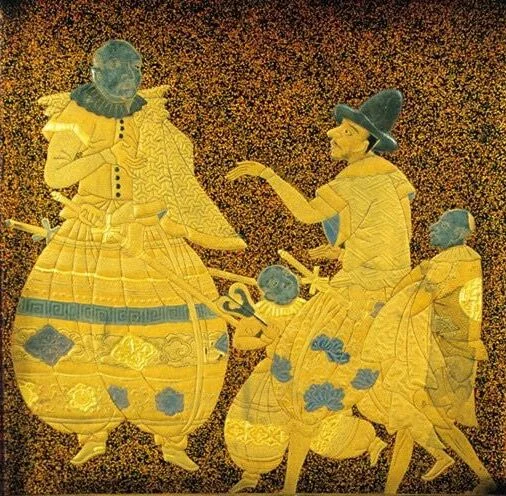
Yasuke
Yasuke was an African man who entered the service of the Japanese warlord Oda Nobunaga in the late sixteenth century. His brief appearance in surviving records has made him one of the most discussed outsiders in Japan’s age of civil war. The documents establish that he lived at Nobunaga’s court and became a retainer; they reveal little about his childhood, exact homeland, or life after 1582.
Arrival in Japan
Yasuke’s story becomes visible in records around 1581, when he was part of the entourage of Alessandro Valignano, a senior Jesuit visitor traveling through Japan. The Jesuit Luís Fróis wrote of the striking public interest surrounding an African man who came to Kyoto. Japanese accounts also describe a man from a Christian country who attracted crowds.
The records do not securely identify where Yasuke was born or how he reached Asia. Later accounts have proposed different African origins and routes through Portuguese trading networks, but these remain conjectures. Even the name “Yasuke” is preserved in the context of his time in Japan; little can be said with confidence about the name he used earlier in life.
In Nobunaga’s service
Oda Nobunaga, then one of the most powerful military leaders in Japan, received Yasuke in 1581 and took him into his household. Contemporary and near-contemporary sources say he was given a Japanese name, a residence, and a short sword, and that he served Nobunaga as a retainer and weapon bearer. His presence was unusual enough to draw attention from both Jesuit observers and Japanese chroniclers.
Yasuke is often called the first African samurai, a description that captures his place in popular memory but can make the evidence sound more definitive than it is. The sources support that he held a role in Nobunaga’s service and was treated as a retainer. They do not provide a detailed account of a formal warrior rank or career, and historians differ over how modern terms such as “samurai” should be applied to the position he held.
The Honnō-ji crisis
In June 1582, Nobunaga was attacked at Honnō-ji in Kyoto by the forces of his former general Akechi Mitsuhide. Nobunaga died during the attack, and his son Nobutada was also killed soon afterward. A record by the retainer Matsudaira Ietada places Yasuke in the events following the coup: he was captured by Mitsuhide’s men and then sent to a Jesuit church.
That brief episode is the last clear trace of Yasuke in the historical record. Nothing reliable establishes whether he returned to the Jesuits, left Japan, or how long he lived. Later stories have filled the gap with dramatic adventures, but they should be distinguished from the sparse contemporary evidence.
A small record, a lasting presence
Yasuke’s documented years in Japan were short, yet they open a window onto the global connections of the sixteenth century. Jesuit missions and Portuguese trade linked Japan to African and Asian routes, while the country’s competing warlords encountered people and objects from far beyond the archipelago. Yasuke’s presence at Nobunaga’s court made those connections visible in a personal way.
Modern books, films, and games have expanded his story, sometimes turning him into a legendary warrior. The surviving evidence offers a quieter but still remarkable picture: an African man whose service at a powerful Japanese court was noticed by people around him and recorded in sources that have preserved his name.
