Yasunary Kavabata
 Japan
JapanBiography of Yasunari Kawabata
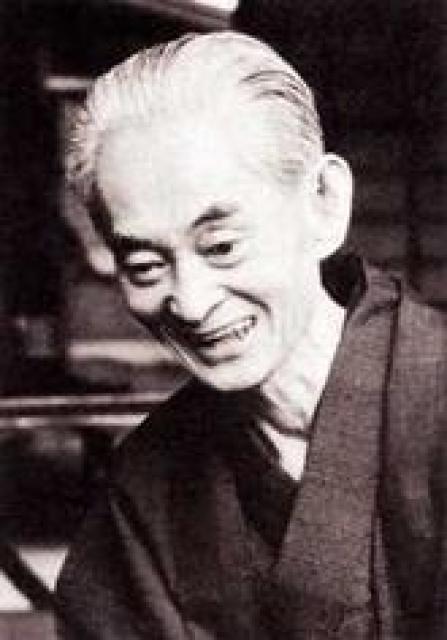
Yasunari Kawabata was a Japanese writer and the recipient of the Nobel Prize in Literature in 1968. He was born in Osaka into an educated and wealthy family. When Kawabata was only 2 years old, his father, a doctor, passed away. A year later, his mother also died, leaving the young boy to be raised by his maternal grandparents. Several years later, both his grandmother and sister passed away, and Kawabata remained with his beloved grandfather.
While he initially dreamed of becoming an artist during his childhood, at the age of 12, Kawabata decided to become a writer. In 1914, shortly before his grandfather's death, he started writing an autobiographical story which was published in 1925 under the title "Diary of a Sixteen-Year-Old". While living with his relatives, Kawabata attended a Tokyo middle school and became interested in European culture. He developed a passion for Scandinavian literature and acquainted himself with the works of artists such as Leonardo da Vinci, Michelangelo, Rembrandt, and Paul Cézanne.
In 1920, Kawabata entered the University of Tokyo to study English literature but eventually switched to studying Japanese literature during his second year. His article in the student magazine "Shin'eite" ("New Direction") caught the attention of writer Kan Kikuchi, who invited Kawabata to join the editorial board of the literary journal "Bungei Shunju" ("Literature Era") in 1923, during his final year of studies.
During this time, Kawabata and a group of young writers founded the magazine "Bungei Jidai" ("Modern Literature"), which became a platform for the "shinkankakuha" ("new sensuality movement") in Japanese literature. This movement was heavily influenced by Western modernist writers, particularly James Joyce and Gertrude Stein. Kawabata's first literary success came with the novella "The Dancing Girl of Izu" (1925), which tells the story of a student who falls in love with a young dancer. Throughout his career, Kawabata often explored the themes of the innocent heroine and the autobiographical hero, which were present in this early work.
In the 1930s, Kawabata's writing became more traditional as he moved away from his earlier literary experiments. In 1934, he began working on "Snow Country," a novel about the relationship between a Tokyo dilettante and an older geisha from the countryside. Written with ellipsis and an elliptical style inspired by the 17th-century Japanese poetic form "haiku," "Snow Country" lacks a coherent plot and consists of a series of episodes. Kawabata worked on the novel for several years, with the first version appearing in print in 1937 and the final version being published a decade later.
During World War II and the post-war period, Kawabata tried to distance himself from politics and remained unresponsive to the events happening in the country. He traveled extensively in Manchuria and devoted much of his time to studying the "Tale of Genji," a classic 11th-century Japanese novel. In his enigmatic tale "Thousand Cranes" (1949), which is based on the traditional Japanese tea ceremony, elements of the "Tale of Genji" can be seen. Although "Thousand Cranes" is the best-known of Kawabata's works in the West, many critics believe that "The Sound of the Mountain" (1954), a family crisis told in sixteen episodes, is a more accomplished piece.
In 1931, Kawabata married Hideko and settled with his wife in Kamakura, the ancient samurai capital of Japan, located north of Tokyo. They had a daughter together. They spent their summers in the mountain resort of Karuizawa in a Western-style cottage and lived in a Japanese-style house in Zushi during the winter. Kawabata had a nearby apartment where he worked, dressed in traditional Japanese kimono and wooden sandals.
In 1960, with the support of the U.S. State Department, Kawabata embarked on a tour of several American universities, including Columbia University, where he conducted seminars on Japanese literature. In his lectures, he highlighted the continuity of Japanese literature from the 11th to the 19th century and the profound changes that occurred at the end of the previous century when Japanese writers were heavily influenced by their Western counterparts.
Perhaps due to the growing influence of Yukio Mishima (a right-wing writer, actor, and political activist), in the late 1960s, Kawabata abandoned his political neutrality and, along with Mishima and two other writers, signed a petition against the "Cultural Revolution" in Communist China.
Kawabata received the Nobel Prize in Literature in 1968 for his writing skill in capturing the essence of the Japanese consciousness. As the first Japanese writer to receive this prestigious award, Kawabata expressed his deep gratitude, stating that throughout his life, he had sought beauty and would continue to do so until his death. With his typically modest demeanor, he admitted that he did not understand why he was chosen for the Nobel Prize but recognized the burden of fame for a writer.
In 1970, Mishima, who had previously attempted a failed uprising at a Japanese military base, committed seppuku (ritual suicide). Two years later, Kawabata, who had just been discharged from the hospital after being treated for drug addiction, also took his own life by inhaling gas at his home in Zushi. This act shocked the entire nation of Japan and the literary world. As Kawabata did not leave a suicide note, the motives behind his suicide remain unclear. Some speculated that his decision might have been influenced by Mishima's similar act, which deeply affected the writer.
In his Nobel lecture, Kawabata spoke about suicide, stating that no matter how alienated a person might be from the world, suicide cannot be a form of protest. He emphasized that even if a person is ideal in every other aspect, committing suicide is far from sanctity.
In Kawabata's novels, modernist techniques and elements of traditional Japanese culture intertwine. In an article published in The New York Times, Takashi Oka noted that in Kawabata's work, "Western influence has been transformed into something purely Japanese, yet his books remain within the realm of world literature."
In addition to the Nobel Prize, Kawabata received the "For the Development of Literature" Prize in 1937, the Literature Award from the Academy of Arts in 1952, and was admitted to the Japan Art Academy in 1954. He was awarded the Goethe Medal in 1959 and received the French Order of Arts and Literature in 1960. Kawabata served as the president of the Japanese PEN Club from 1948 to 1965 and later became the vice president of the International PEN Club from 1959 onwards.