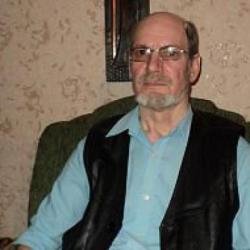
Yuliy Daniel
- Early Life and Military Service
- Education and Career
- Literary Debut and Political Suppression
- Imprisonment and Resistance
- Post-Release and Translations
- Notable Anti-Utopia and Political Commentary
- Legacy
Early Life and Military Service
Yuly Markovich Danielwas born November 15, 1925, in Moscow, the son of Jewish writer Moisei Nikolayevich Meerovich, who published under the pseudonym M. Daniel. During the Great Patriotic War, from 1943 to 1944, Daniel served on the front lines and sustained severe injuries.
Education and Career
After the war, Daniel completed his education at the Moscow Regional Pedagogical Institute in 1950. He initially worked as a school teacher in the Kaluga Region and later in Moscow. In the mid-1950s, he established himself as a translator of poetry from various languages, including Kalmyk, Armenian, Azerbaijani, and North Caucasian tongues.
Literary Debut and Political Suppression
In 1956, Daniel published his historical novel, "The Escape," which explored the unconventional life of a self-taught peasant in 18th-century Russia. However, his career took a dramatic turn in 1958with the publication abroad of his novel, "Moscow Speaks." This, along with other works, led to his arrest in September 1965. His novel, "The Escape," was also banned, though an abridged version was later published in the magazine 'Pioneer' in 1989.
Imprisonment and Resistance
Sentenced to five years in a strict-regime labor camp in 1966, Daniel did not succumb to silencing. During his imprisonment, he wrote a series of poems and the poetic cycle, "Meanwhile..." He also translated the works of Latvian poet Kārlis Skujenieks, his fellow inmate.
Post-Release and Translations
Upon his release, Daniel published translations under the pseudonym "Yu. Petrov" of poetry from Scottish, Georgian, Byron, Wordsworth, Hugo, Baudelaire, and Rimbaud, among others. His own fiction, influenced by Kafka's modernist style, continued to explore themes of the individual in an absurd world.
Notable Anti-Utopia and Political Commentary
Daniel's novel, "Moscow Speaks," stands out as a significant work in the anti-utopian genre. It depicts a society where the Supreme Soviet legalizes a "Day of Open Murders," leading to a chilling complacency among citizens. His novel, "Atonement," also probes the psychological effects of false accusations and social paranoia.
Daniel's political views are evident in his conceptual essays, "Letter to a Friend" (1969) and "Response to I.R. Shafarevich" (1975). His works have been translated into multiple languages, and some of his poems have been set to music in the form of "author's songs."
Legacy
Yuly Daniel passed away on December 30, 1988, in Moscow. His writings continue to resonate, offering a profound and poignant examination of the human condition in the face of political repression and social absurdity.