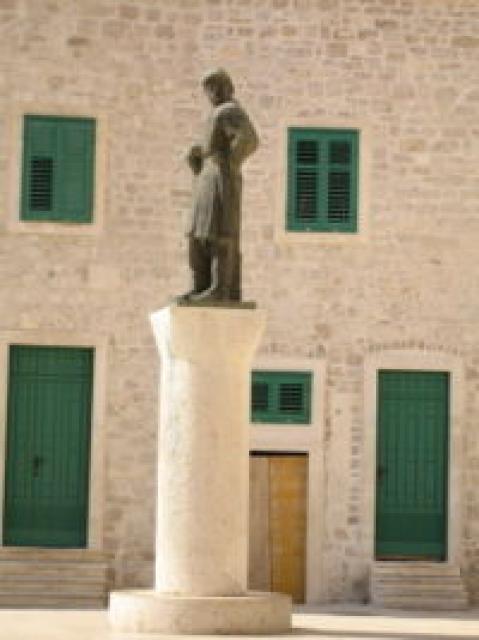
Yuray Dalmatinats
 Croatia
- Juraj Dalmatinac: Croatian Renaissance Master
- A Renaissance Master from Dalmatia
- Architectural Masterpiece: St. James Cathedral
- Sculptural Legacy and City Planning
- Beyond Dalmatia
- Legacy and Impact
Juraj Dalmatinac: Croatian Renaissance Master
Early Life and InfluencesJuraj Dalmatinac (ca. 1410-1473), known as Giorgio Orsini in Italian and Giorgio da Sebenico (Giorgio of Šibenik), was a prominent Croatian architect, sculptor, and urban planner born in Zadar in the early 15th century. During this period, Dalmatia was largely under Venetian control, fostering a thriving arts scene in coastal cities.
A Renaissance Master from Dalmatia
Dalmatinac, part of a generation of Dalmatian artists, played a crucial role in the architectural and sculptural development of the region. As a product of the blended Romano-Slavic culture, he was initially known solely as Giorgio Orsini. Like many Dalmatians of his time, he is celebrated as a national figure in both Croatia and Italy.
Architectural Masterpiece: St. James Cathedral
Dalmatinac's most renowned work is the monumental St. James Cathedral in Šibenik, a UNESCO World Heritage Site. To construct this architectural marvel, he devised an innovative stone masonry technique that allowed him to build the cathedral entirely of stone without using bricks or wooden beams. The cathedral's exterior is adorned with 74 sculptures depicting Dalmatinac's contemporaries, a testament to his artistic prowess.
Sculptural Legacy and City Planning
Dalmatinac's sculptural skills are evident in the captivating stone altar of St. Domnius Cathedral in Split. He also excelled as an urban planner, contributing to the design of the city of Pag on the island of the same name and the reconstruction of the Dubrovnik fortress.
Beyond Dalmatia
Dalmatinac's influence extended beyond Dalmatia, as evidenced by his works in Ancona, Italy, including the Palazzo dei Mercanti and the portal of the Church of San Francesco.
Legacy and Impact
Dalmatinac passed away in Šibenik in 1473, leaving behind a rich artistic legacy. His innovative techniques and artistic masterpieces have left an indelible mark on Croatian and Dalmatian culture. To this day, he is revered as a master of the Renaissance who bridged the gap between two worlds, cementing his place in both Croatian and Italian history and artistic traditions.