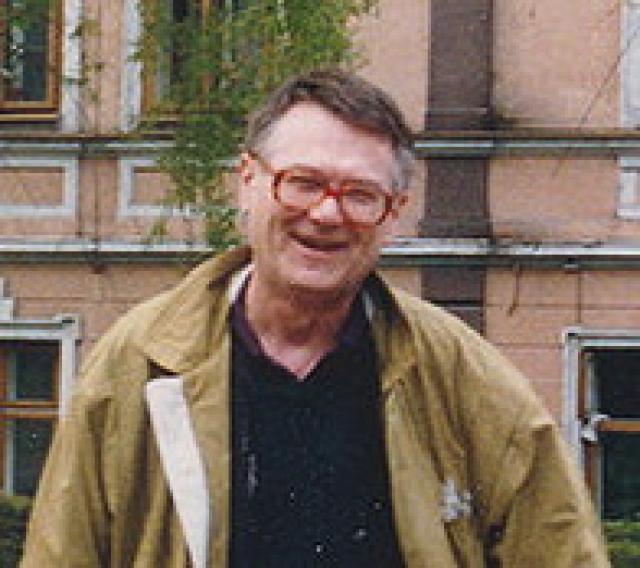
Zdzislaw Beksinski
 Poland
- Zdzislaw Beksinski: A Master of the Macabre
- Artistic Awakening in Photography
- Transition to Painting
- Critical Recognition and Public Exhibitions
- Artistic Destruction and Digital Exploration
- The Gothic and Baroque Distinction
Zdzislaw Beksinski: A Master of the Macabre
Early Life and Architectural BackgroundZdzislaw Beksinski was born in the southern Polish town of Sanok. Following his architectural studies in Krakow in 1955, he returned to Sanok. For several years, Beksinski worked as a construction site foreman, a job he loathed.
Artistic Awakening in Photography
During this period, Beksinski's artistic interests expanded into photography, photomontage, sculpture, and painting. As an artist, he proved to be highly innovative, especially within the confines of a communist country. He created sculptures from plaster, metal, and wire. Stylistically, Beksinski's photographs foreshadowed his future paintings, featuring images of wrinkled faces, craggy landscapes, and heavily textured objects, enhanced by dramatic lighting and shadow play. The photographs also exhibited a penchant for unsettling imagery, such as a disfigured doll with a torn face, portraits of people without features, and faces completely bandaged.
Transition to Painting
Beksinski eventually shifted his creative focus to painting. His early paintings leaned towards abstraction, but throughout the 1960s, he gravitated towards surrealism. By the 1970s, Beksinski had entered the "fantastic" period, which lasted until the late 1980s. This period is his most well-known, where he produced his most striking and iconic images—surreal, post-apocalyptic visions depicting scenes of death, decay, landscapes strewn with skeletons, and contorted bodies, all rendered with meticulous attention to detail, especially in the depiction of rough, gnarled surfaces. His large-scale paintings share a kinship with the elaborate and intricately detailed work of Austrian artist Ernst Fuchs.
Critical Recognition and Public Exhibitions
Despite the grim subject matter, Beksinski believed that many of his works were misunderstood, suggesting that they were fundamentally optimistic and even humorous. Beksinski's exhibitions were consistently successful. His 1964 Warsaw exhibition marked his first major breakthrough, where all of the showcased paintings sold out. By the 1980s, his works had gained traction in France, establishing him as a widely celebrated artist in Western Europe, Japan, and the United States.
Artistic Destruction and Digital Exploration
Prior to moving to Warsaw in 1977, Beksinski burned a selection of his works in his backyard, leaving no record of them. He later explained that some were "too personal," while others he deemed unsatisfactory and did not want them to circulate. The 1980s marked a period of transition, with his early 1990s work consisting primarily of surreal portraits and crosses. These works were less detailed than those of the "fantastic period," but no less compelling and powerful. In the latter half of the 1990s, Beksinski embraced computers, the internet, and digital photography, which he continued to explore until his death.
The Gothic and Baroque Distinction
Beksinski consistently categorized his works into two distinct styles: "baroque" and "gothic." The former emphasized fullness, while the latter focused on form. The paintings from the last five years of his life predominantly fall within the "gothic" category.