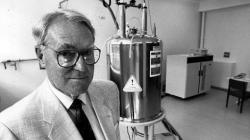
Aaron Klug
 Lithuania
Biography of Aaron Klug
Aaron Klug was a British and South African scientist and biochemist. He was born in Zhelvas, Lithuania, to a family of cattle traders Lazar Klug and Bella Silina Klug. When Klug was two years old, his family moved to Durban, South Africa, where his mother's family had emigrated in the early 20th century. Klug attended Durban High School from 1937 to 1941. It was during this period that his interest in science began, especially after reading the book "Microbe Hunters" by American writer Paul de Kruif.

In 1942, Klug enrolled at the University of the Witwatersrand in Johannesburg, where he started a pre-medical course but soon developed a strong interest in physics. After graduating in 1945 with a Bachelor of Science degree, he continued his studies at the University of Cape Town on a scholarship, focusing on X-ray crystallography under the guidance of his teacher R. W. James. This method allowed him to study the arrangement of atoms inside a crystal by analyzing the diffraction of X-ray beams.

In 1949, Klug moved to England with a scholarship from the 1851 Exhibition and a research grant from Trinity College, Cambridge. He applied for a research position at the Cavendish Laboratory, but due to limited availability, he ended up studying the molecular structure of steel under the supervision of D.R. Hartree. In 1952, he obtained his doctorate for this work.
In 1953, Klug joined the Department of Colloid Chemistry at the University of Cambridge, where he began researching the biophysical processes of oxygen and carbon dioxide exchange in hemoglobin. This research further fueled his interest in X-ray analysis of biological molecules. In 1958, he became the head of a research group at Birkbeck College, University of London, studying the structure of the tobacco mosaic virus.
In 1972, Klug developed a method called crystallographic electron microscopy, which combined electron microscopy with laser diffraction to determine the structure of biological complexes. This method allowed him to study the complex organization of cells and molecules, providing valuable insights into the nature of cancer and genetic information.
Klug's groundbreaking work earned him numerous accolades, including the Nobel Prize in Chemistry in 1982. He continued his scientific research at the Laboratory of Molecular Biology in Cambridge and also served as one of the leaders of the Medical Research Council's Laboratory of Molecular Biology.
Aside from the Nobel Prize, Klug received honorary degrees from Columbia University, the University of Chicago, the University of Strasbourg, and Stockholm University. He was also awarded the H.P. Heineken Prize by the Royal Netherlands Academy of Arts and Sciences and the Louisa Gross Horwitz Prize by Columbia University. Klug was a member of the Royal Society and an honorary foreign member of the American Academy of Arts and Sciences.
Klug was known for his dedication to both scientific research and teaching. He was highly respected by his students and colleagues. In 1949, he married Liebe Broubau, and the couple had two sons.