Admetus
Admetus is a king of Pherae in Thessaly whose story sits at the crossroads of Greek myth, tragedy, and heroic legend. Ancient tales remember him as the host of Apollo and the husband of Alcestis, whose willingness to die in his place became one of antiquity’s most enduring stories of marital devotion. Their legend inspired Euripides’ tragedy *Alcestis* and was retold by writers for centuries.
King of Pherae
Admetus was said to be the son of Pheres, founder of Pherae, and to have succeeded him as ruler of the Thessalian city. He appears in several strands of Greek mythology, though details vary between ancient authors. In Homer’s *Iliad*, Admetus is connected to the Trojan War through his son Eumelus, who leads a contingent from Pherae.
The best-known story begins with Apollo serving as a herdsman in Admetus’ household. In one tradition, Zeus had punished the god by making him work among mortals. Admetus treated Apollo kindly, and the god repaid his hospitality by helping him win the hand of Alcestis, the daughter of King Pelias. To satisfy her father’s condition, Admetus had to yoke a lion and a boar to a chariot; Apollo made the impossible task possible.
The Bargain with Death
A second legend gave Admetus a reprieve from death. Apollo persuaded the Fates to allow the king to live beyond his appointed time if another person willingly died in his place. When the moment came, neither Admetus’ aged parents nor anyone else stepped forward. Alcestis alone agreed to take his place.
The story became the central drama of Euripides’ *Alcestis*, first performed in 438 BCE. The play asks what love, gratitude, and obligation require of its characters. Admetus accepts his wife’s sacrifice, then confronts the consequences of surviving at her cost. His grief is complicated by shame and by the realization that the people he expected to die for him had refused.
Heracles and Alcestis’ Return
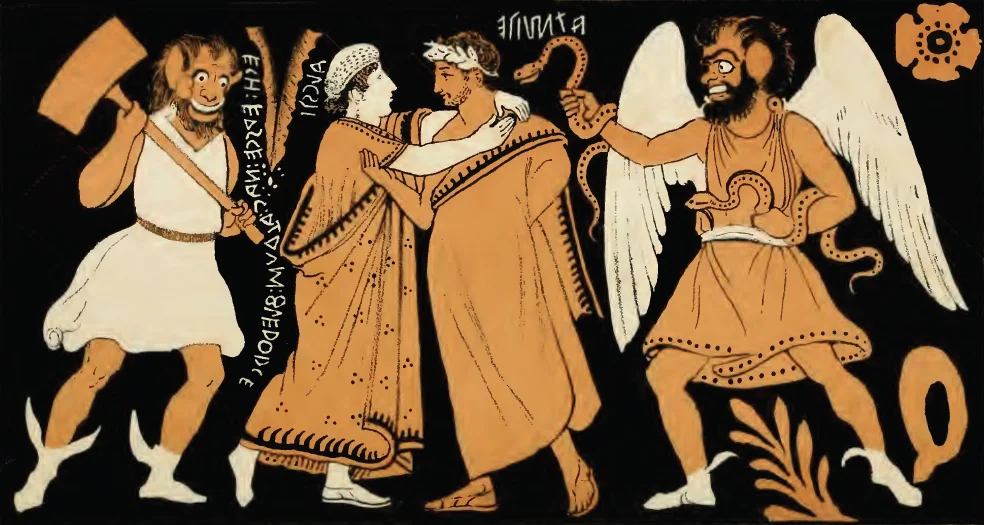
The myth’s ending varies. In Euripides’ play, Heracles arrives at the palace without initially knowing what has happened. When he learns that Alcestis has died, he wrestles with Death and brings her back. Other versions say that Persephone, moved by Alcestis’ devotion, released her from the Underworld.
Heracles’ rescue completes the tale with a rare hopeful reversal: the wife who entered death in her husband’s place returns to the world of the living. The rescue also turns the story into a test of hospitality. Admetus welcomes Heracles even while grieving, and the hero repays that welcome by restoring Alcestis.
An Enduring Tragic Figure
Admetus is not remembered for battles or conquest, but for the moral dilemmas gathered around his household. His story has invited audiences to debate whether his acceptance of Alcestis’ sacrifice was understandable, selfish, or both. Euripides leaves room for that tension, making the king a complicated figure rather than a simple hero.
Across ancient poetry and drama, Admetus’ myth explores mortality, love, hospitality, and the obligations people owe one another. The tale of Alcestis ensured that the king of Pherae would be remembered not only as a figure from heroic tradition but as the central character in one of Greek tragedy’s most moving reflections on devotion and loss.