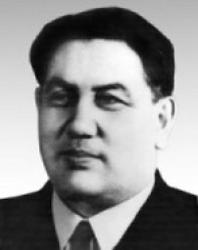
Adolf Butenandt
 Germany
Biography of Adolf Butenandt
Adolf Butenandt was a German organic and biochemist who made significant contributions to the field of hormone research. He was born on March 24, 1903, in Lehe, Germany. Butenandt was the first to isolate and synthesize several sex hormones, including estrone, testosterone, and progesterone. His groundbreaking work in this area earned him the Nobel Prize in Chemistry in 1939.
Butenandt pursued his education at the University of Marburg and the University of Göttingen from 1924 to 1927. He then went on to work at the University of Göttingen from 1931 to 1933 and the Technical University of Danzig (now Gdansk, Poland) from 1933 to 1936. During these years, he made significant discoveries, including isolating the male sex hormone androsterone in crystalline form in 1931. He also determined its chemical structure and later synthesized a second male sex hormone, testosterone, in 1939.
In the same year, Butenandt isolated a new substance in the "yellow body" of the ovaries and named it progesterone. He obtained it in crystalline form in 1934 after synthesizing it. His research extended beyond human hormones, and in 1961, he successfully isolated and identified the insect sex hormone, pheromone.
Despite his remarkable achievements, Butenandt faced obstacles during his career due to the political climate in Nazi Germany. The Nazi regime prohibited him from receiving the Nobel Prize, and it was only a decade later that he was able to travel to Stockholm to be awarded the gold medal and diploma of the laureate.
Throughout his career, Butenandt held prestigious positions in various institutions. He served as the director of the Institutes of Biochemistry in Berlin from 1936 to 1944, in Tübingen from 1944 to 1956, and in Munich from 1956 until his retirement. From 1960 to 1972, he was the president of the Max Planck Society in Munich.
Adolf Butenandt's contributions to the field of hormone research revolutionized our understanding of reproductive biology and paved the way for further advancements in endocrinology. His work continues to be celebrated and remembered, not only for its scientific significance but also for the perseverance he demonstrated in the face of adversity.