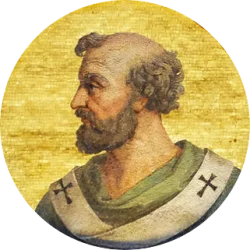
Adrian III
Adrian III’s brief papacy unfolded amid factional conflict in Rome and the fading unity of the Carolingian Empire. He was summoned north by Emperor Charles the Fat to discuss the future of imperial rule, but died on the journey. Though little is known about his policies, his burial at the monastery of Nonantola became the foundation of a local cult that was recognized centuries later.
Election in a Divided Rome
A Roman and the son of Benedict, Adrian was elected pope in 884, succeeding Marinus I. The city was then a center of competing aristocratic and ecclesiastical factions. Later chroniclers describe severe punishments during his rule, signs of the unrest that marked Roman politics in the period, although the sparse record makes it difficult to reconstruct events in detail.
Some medieval accounts credit Adrian with declaring that future popes could be consecrated without waiting for imperial confirmation, or with arranging for the imperial title to pass to an Italian ruler. These stories lack contemporary support and are generally treated with caution by historians.
Summoned to the Imperial Court
In 885, Charles the Fat invited Adrian to attend an assembly at Worms. The emperor had no legitimate son, and the meeting was expected to address the question of succession as well as other political concerns. The invitation reflected the pope’s potential importance in a decision about imperial power, even though the relationship between Rome and the Carolingian rulers was often complicated.
Adrian set out from Rome but died near Modena before reaching the assembly. He was buried at the monastery of Nonantola, where his memory was honored locally. Sources differ over the precise date of his death, which is generally placed in the summer or early autumn of 885.
Cult and Legacy
Adrian’s local veneration endured at Nonantola, and Pope Leo XIII formally approved his cult in 1891. His life remains difficult to narrate because little contemporary evidence survives and later stories sometimes embellished his actions. What can be said with confidence is that his papacy coincided with a period of political instability, and his untimely death removed him from a succession debate that could have influenced the future of the empire.