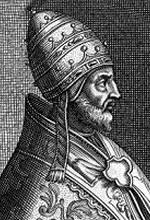
Adrian V
Adrian V’s papacy lasted only a few weeks, but before his election he had spent decades as a diplomat and senior papal official. Born Ottobuono Fieschi, he helped negotiate between the English crown and its rebellious barons, then became pope during a turbulent year of repeated elections. His brief reign ended before he could be ordained as a priest or consecrated as a bishop.
From Genoa to the Papal Court
Ottobuono Fieschi was born in Genoa around 1205 into the powerful Fieschi family. His uncle became Pope Innocent IV, and the family connection helped open a path into the papal administration. Ottobuono became a cardinal deacon and served in the curia under several popes, gaining experience in diplomacy and church government.
In 1265 Pope Clement IV sent him as papal legate to England. The country was recovering from the Second Barons’ War, a conflict between King Henry III and a group of nobles who had challenged royal authority. Ottobuono’s mission included restoring peace, securing support for a crusade and helping re-establish the king’s position. He remained in England until 1268, becoming involved in negotiations that shaped the settlement between the crown and its opponents.
A Short Papacy
Ottobuono was elected pope at Viterbo in July 1276, taking the name Adrian V. His elevation came during a year of rapid papal change: he followed Innocent V and was himself succeeded by John XXI. Adrian’s pontificate lasted only about five weeks. He died at Viterbo on August 18, 1276, before he could be ordained a priest or consecrated as a bishop.
Despite the short reign, Adrian took a significant step concerning papal elections. In 1274 the Second Council of Lyon had established rules for conclaves, known as Ubi periculum, which required cardinals to remain secluded while choosing a new pope. At the cardinals’ request, Adrian suspended the rules shortly after his election, apparently intending to revise them. His death left the question unresolved, and a later pope formally confirmed the suspension.
Legacy and Reputation
Adrian’s reputation rests less on his papal actions than on his earlier diplomatic service and the unusual brevity of his reign. His work in England placed him at the center of a major dispute over royal and baronial power. His election, meanwhile, occurred during the politically unsettled period known as the Year of Four Popes in 1276.
Dante later placed a figure based on Adrian in the Purgatorio section of the Divine Comedy, reflecting the poet’s fascination with the moral responsibilities of church leaders. The brief pontificate left few opportunities for a lasting program, but Adrian’s career illustrates the reach of medieval papal diplomacy—from negotiations in England to the contested politics of the papal succession.