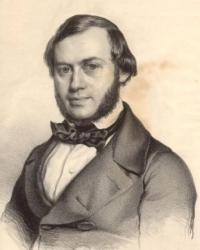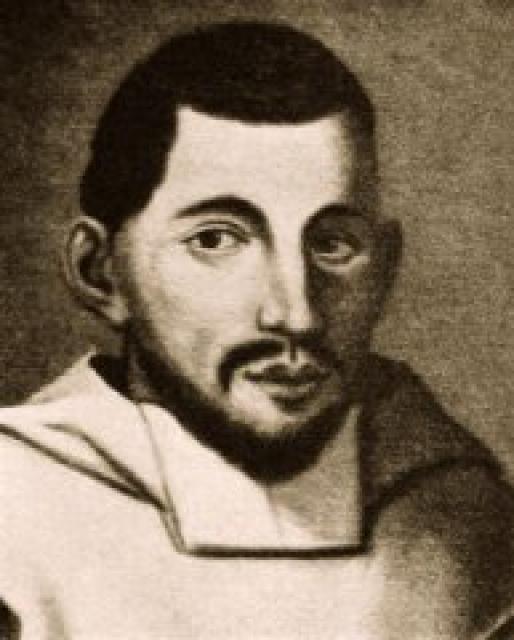
Adriano Banchieri
 Italy
ItalyBiography of Adriano Banchieri
Adriano Banchieri was an Italian composer, musical theorist, organist, and poet of the late Renaissance and early Baroque era. He was born and died in Bologna, Italy. He was born on September 3, 1568, with the name Tommaso Banchieri, in a family from Lucca, a historic town in eastern Italy.
In 1587, he entered the Olivetan Order, a branch of the Benedictines, and in 1590, he took his vows and changed his name to Adriano. One of his teachers in the monastery was Gioseffo Guami, who significantly influenced the musician's style. He began his career as an organist in the San Michele monastery in Bosco, in the province of Bologna, and then worked in Imola, Gubbio, Venice, and Verona.
In 1610, he was appointed organist of the Monte Oliveto Maggiore abbey, and in 1611, he returned to San Michele in Bosco. Here, he became a key figure in the musical life of Bologna. In 1615, he founded the Accademia dei Floridi, which was restored in 1623 by Girolamo Giacobbi and renamed Accademia dei Filomusi. In 1624, he was awarded the honorary title of abbot.
Contributions to Music
Like the composer Orazio Vecchi, Banchieri was interested in using the madrigal form for dramatic purposes while opera was still in its early stages of development. He developed a form called "madrigal comedy," which consisted of a collection of madrigals performed sequentially to tell a complete story. The madrigal comedy was considered an important precursor to opera, but is now recognized as a distinct genre that evolved independently as part of Italy's interest in creating music-dramatic forms.
Additionally, Banchieri was an influential composer of canzonettas, a light and popular alternative to the madrigal in the late 16th century. He also expressed disapproval of the supporters of monody and their revolutionary harmonic tendencies in his work "Moderna Practica Musicale" (1613) and was one of the first to use thoroughbass in his compositions.
In several editions, starting from 1605 and reprinted at least six times until 1638, Banchieri published a series of organ compositions titled "l'Organo suonarino." His last published work was "Trattenimenti da villa" in 1630. He is known to have written five madrigal comedies between 1598 and 1628, with plots and character development, starting with "La pazzia senile" in 1598 and ending with "La saviezza giovenile."
Apart from his musical compositions, Banchieri left behind several prose comedies under the pseudonym Camillo Scaligeri, written in mixed Tuscan dialects. Their structure is typical of 16th-century theater, with multiple intrigues connected by a single plot. In the 17th century, Banchieri was considered one of the most influential music teachers, and his collections of works were aimed more at students than teachers, which was a significant innovation in the field.
Adriano Banchieri passed away in 1634, not surviving the effects of a stroke.