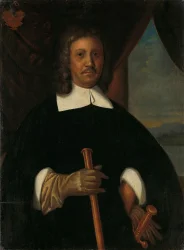
Afonso de Albuquerque
Afonso de Albuquerque helped turn Portugal’s early voyages into a durable military and commercial presence across the Indian Ocean. A soldier, admiral, and administrator, he captured Goa and Malacca and sought control of strategic ports linking the Atlantic, the Persian Gulf, the Red Sea, and Asian trade routes. Celebrated in Portugal as a founder of its eastern empire, he was also a forceful conqueror whose campaigns brought violence and dispossession to the communities he targeted.
A nobleman in royal service
Albuquerque was born around 1453 in Estremadura, Portugal, into a noble family connected to the royal court. As a young man he served in campaigns in North Africa and gained experience as a soldier and court official. Under King John II, he advanced through military service and became familiar with Portuguese ambitions to reach and control the trade routes of the East.
In 1506, he sailed east with a fleet tasked with operating in the Indian Ocean. He pursued a strategy based on holding key ports and straits rather than simply raiding ships. By controlling chokepoints, the Portuguese crown hoped to protect its own shipping, divert valuable commerce, and challenge the established networks of Muslim and Asian traders.
Governor of Portuguese India
After a dispute with his predecessor Francisco de Almeida, Albuquerque took over as governor of Portuguese India in 1509. His defining conquest came in Goa, a prosperous port on India’s western coast. Portuguese forces captured the city in February 1510 but could not hold it. They returned later that year and took it again. The conquest involved severe bloodshed and the seizure of property, leaving a lasting mark on the city’s history.
Albuquerque made Goa the central base of Portuguese power in the region. He strengthened its fortifications and administration, using it as a staging point for further campaigns. His policies also aimed to create a permanent Portuguese presence: he encouraged soldiers to settle and marry local women, helping establish a colonial community tied to the crown. Such settlement policies were shaped by imperial aims and operated in the unequal conditions of conquest.
In 1511, Albuquerque led the capture of Malacca on the Malay Peninsula, a major commercial hub at the junction of important maritime routes. The Portuguese built a fort there and used the city as a base for reaching trade networks extending toward the Indonesian archipelago and China. He also pursued control of Hormuz at the entrance to the Persian Gulf, a strategic position for commerce and naval power.
Power and controversy
Albuquerque’s approach combined military force with political alliances and administrative planning. He sought to weaken rival rulers and restrict the movement of competing merchants, while also negotiating with local leaders when it served Portuguese interests. His campaigns were not simply exploratory ventures: they were part of an expanding imperial project that sought to command trade through fortified ports.
In 1515, King Manuel I replaced him as governor. Albuquerque was sailing back toward Goa when he learned of the decision. He died at sea near Goa on 15 December 1515, before he could return to Portugal.
Legacy
Albuquerque’s conquests established a network of Portuguese bases that shaped the empire in Asia for generations. His name remains prominent in Portuguese national memory, where he is honored for strategic vision and military success. In the places he conquered, however, his legacy is inseparable from occupation, violence, and the redirection of local commerce to serve foreign rule. His career captures both the boldness and the human cost of early modern European empire-building.