Ahmad Chalabi
 Iraq
IraqBiography of Ahmad Chalabi
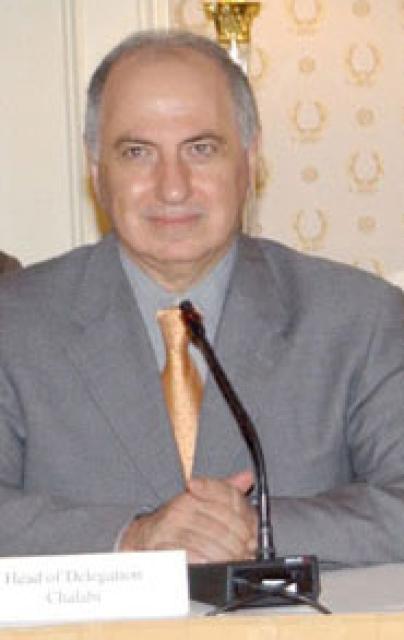
Ahmad Chalabi was a representative of a wealthy and influential Iraqi family. He was a distant relative of Iraqi Prime Minister Ayad Allawi and Defense Minister Ali Allawi. Chalabi belonged to the Shia sect of Islam. After the anti-monarchist revolution in Iraq in 1958, he, along with his brothers Hazim and Jawad, was exiled to Lebanon with his family. He received his higher education in the United States, graduating from the Massachusetts Institute of Technology. He then completed his doctoral degree at the University of Chicago under the guidance of Leo Strauss before returning to Lebanon, where he became a professor at the American University of Beirut.
While studying in the US, Ahmad Chalabi established important connections, including with Paul Wolfowitz and Richard Perle, who later became prominent figures in the Republican Party. In 1977, he moved to Jordan and founded the largest private bank, Petra, with the support of Crown Prince Hassan, a member of the Jordanian royal family. At the same time, Chalabi's brothers founded the Swiss financial corporation Socofi. Both companies went bankrupt in the late 1980s due to the financial machinations of the Chalabi brothers.
Chalabi went into hiding in London. In the meantime, a Jordanian court sentenced him in absentia to 22 years in prison for banking fraud and misappropriation of funds, while his brothers received suspended sentences in Switzerland. In 1992, after the first Gulf War, Ahmad Chalabi founded the "Iraqi National Congress" (INC) in London with the support and financing of US intelligence agencies. The INC was intended to be the leading political force in Iraq after the overthrow of Saddam Hussein. In 1995, the INC made an unsuccessful attempt to organize a Kurdish uprising in northern Iraq. In recent years, Chalabi has become one of the main advisors to the administration of George W. Bush on Iraq and has been involved in providing information and propaganda support for US plans to overthrow Saddam Hussein, claiming that he possessed weapons of mass destruction.
Chalabi enjoyed special favor at the Pentagon because Paul Wolfowitz and Richard Perle were among the closest advisors to the US Secretary of Defense. However, the State Department and the CIA had long ceased to trust him. With the start of Operation "Shock and Awe," Ahmad Chalabi returned to Iraq from exile and joined the Iraqi Governing Council, a special body functioning under the US occupation administration from 2003 to 2004.
His nephew, Salem Chalabi, is the chairman of the special tribunal established for the trial of Saddam Hussein. Meanwhile, no weapons of mass destruction or evidence of their production were found in Iraq, and the organizers of the operation - the US and the UK - needed a scapegoat. Chalabi became the best candidate, especially since neither he nor his party enjoyed authority in Iraq, as it turned out.
However, Ahmad Chalabi did not abandon his aspirations for real power, hoping to become the Prime Minister or President. In order to gain popularity among Iraqis, he made statements in the fall of 2003 that Iraqis should govern their own country. This only convinced the US to withdraw its support from Chalabi. In May 2004, Chalabi was accused of providing American secret information to Iran, and although no further charges were brought, he was removed from leadership positions. He denied his guilt and offered to testify before the US Congress to prove his innocence.
On August 9, 2004, the chairman of the Central Investigative Tribunal of Iraq issued an arrest warrant for Ahmad and Salem Chalabi. The arrest warrant alleges that Ahmad Chalabi engaged in currency manipulation, counterfeiting of old-style dinars, and money laundering. Salem was accused of murder. Thus, the US dealt with Chalabi through Iraqi hands, but to avoid an unwanted scandal, the arrest warrants were issued at a time when both defendants were outside Iraq and unlikely to be handed over to the Iraqi authorities. Moreover, Ahmad Chalabi's stay in Iran can be presented as indirect evidence of his guilt.
The Americans thus attempted to get rid of an inconvenient ally, and Ayad Allawi - of his main rival in the race for the position of Prime Minister. Furthermore, Ayad Allawi had long wanted to bring the trial of Saddam Hussein under his control, and now he can easily do so.
On August 10, the Iraqi police and representatives of the occupation authorities demanded that the staff of the INC headquarters vacate the four buildings they occupied. On August 11, Ahmad Chalabi returned to Baghdad from Tehran under the guarantees of the President and the Prime Minister of Iraq that he would not be arrested. According to Ahmad Chalabi, he wants to clear his name of false accusations. On August 12, the Iraqi Minister of Interior, Sabah Kadhim, stated that he currently has no plans to arrest Ahmad Chalabi and will provide him with an opportunity to refute the charges against him. At the same time, on behalf of Ahmad Chalabi, a lawsuit was filed in Washington against Jordan, which, according to Chalabi, instigated his persecution for revealing the involvement of Jordanian authorities in illegal arms purchases for the Saddam Hussein regime.
On September 28, due to a lack of evidence, an Iraqi court dismissed the case against Ahmad Chalabi, who was accused of fraud, forgery of documents and banknotes.