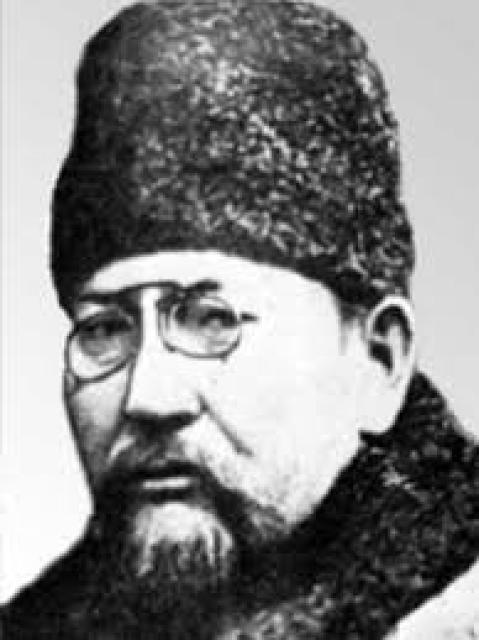
Ahmet Baitursynov
- Early Life and Education of Akmet Baitursynuly
- Teaching and Political Activism
- Kazakh Linguistic Reforms
- Alaş Orda and Soviet Involvement
- Imprisonment and Rehabilitation
- Legacy
Early Life and Education of Akmet Baitursynuly
Akmet Baitursynuly was born on January 28, 1873. At the age of thirteen, his father and three brothers were sent into exile to Siberia for resisting police brutality. Despite these hardships, Baitursynuly pursued his education, studying under village mullahs and enrolling in the Torgay Russo-Kazakh School. He later attended the four-year teacher training school founded by the educator Ibrai Altynsarin in Orenburg, graduating in 1895.
Teaching and Political Activism
From 1895 to 1909, Baitursynuly taught in rural schools throughout Kazakhstan. During this time, he actively participated in political activities, co-authoring the "Karkaraly Petition" in 1905. He was imprisoned for criticizing the tsarist administration in 1907 and again in 1909 for eight months.
Kazakh Linguistic Reforms
Baitursynuly played a pivotal role in reforming the Kazakh written script. In 1912, he created the "Zhana Emle" ("New Orthography") alphabet, which excluded unused Arabic letters and introduced new ones specific to the Kazakh language. This alphabet is still used by Kazakhs living outside of Kazakhstan, including in China, Afghanistan, and Iran.
Alaş Orda and Soviet Involvement
In 1913, Baitursynuly co-founded the newspaper "Kazakh" in Orenburg. The newspaper became a prominent national publication, covering political, scientific, and literary issues. Baitursynuly also helped establish the Kazakh political party "Alash" in 1917 and served as one of the leaders of the Alaş Orda government.
After the establishment of Soviet rule, Baitursynuly initially resisted but later switched sides. He served as the People's Commissar of Education and was a member of the All-Russian Central Executive Committee and the Kazakh Central Executive Committee.
Imprisonment and Rehabilitation
In October 1937, Baitursynuly was arrested and executed on December 8, 1937, as an "enemy of the people." He was posthumously rehabilitated in 1988.
Legacy
Akmet Baitursynuly's contributions to Kazakh culture, language, and politics are immeasurable. His linguistic reforms made it possible for millions of Kazakhs living abroad to access their written heritage. As a political activist, he fought for the rights of his people. His legacy as an author, educator, and visionary continues to inspire countless Kazakhs today.


