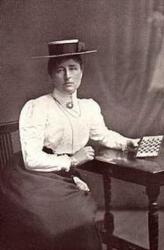
Akiba Rubinstein
 Poland
Biography of Akiba Rubinstein
Akiba Rubinstein (December 12, 1882, Stawiski, Poland – March 15, 1961, Antwerp, or according to other sources, Brussels) was a Polish chess player, considered one of the greatest chess strategists of all time. Prior to World War I, he was regarded as the main rival to Lasker in the fight for the World Chess Championship title. However, after the war, his game lacked consistency, with notable successes being followed by equally notable failures. Nevertheless, few of his contemporaries could boast such a successful tournament career. Rubinstein won the first prizes in international tournaments on eight occasions: Ostend (1907, along with O. Bernstein), Karlsbad (1907), Saint Petersburg (1909, along with E. Lasker), San Sebastian (1912), Pistyan (1912), Breslau (1912, along with Duras), Vienna (1922), and Marienbad (1925, along with Nimzowitsch). He won numerous matches against renowned players such as Salwe (Łódź, 1907, +3-1=4), Marshall (Warsaw, 1908, +4-3=1), Teichmann (Vienna, 1908, +3-2=1), Mieses (Berlin, 1909, +5-3=2), Schlechter (Berlin, 1918, +2-1=3), and Bogoljubov (Stockholm, 1920, +5-4=3). In the early 1930s, Rubinstein led the Polish national team to win gold (1930) and silver (1931) at the Chess Olympiads. His contribution to the team's success in 1930 was particularly notable as he won 13 games and drew 4 games (without any losses) on the first board. Many opening schemes developed by Rubinstein, such as the Queen's Gambit, Nimzowitsch Defense, French Defense, Sicilian Defense, English Opening, and Four Knights' Game, are still relevant to this day. Rubinstein was known for his exceptional skill in playing endgames, especially rook endings, which are considered the most challenging in terms of exploiting advantages. S. Tartakower ("Homer of Chess") once said, "Rubinstein is the rook ending of a game started by gods a thousand years ago."
The Struggles and Legacy
Rubinstein often fell victim to his own nerves and made grave mistakes due to fatigue. In serious tournaments, he frequently fell into checkmate in just 1 or 2 moves. However, his achievements are a testament to his brilliant chess talent. According to Réti ("Chess Manual"), Rubinstein's games epitomize Steinitz's teachings "in their most perfect form." After 1932, Rubinstein's deteriorating mental health forced him to retire from professional chess. He spent the rest of his days in a specialized institution in Belgium. Despite his illness, Rubinstein was not forgotten by his contemporaries. In 1950, he was awarded the title of International Grandmaster based on his overall contributions to chess. Occasionally, fellow chess players would visit him.