Al-Biruni
 Afghanistan
- Early Life and Education
- Intellectual Contributions
- Astronomical Discoveries
- Travels and Intellectual Encounters
- Final Moments and Legacy
Life and Legacy of Al-Biruni: An Intellectual Titan of the Medieval Era
Early Life and Education
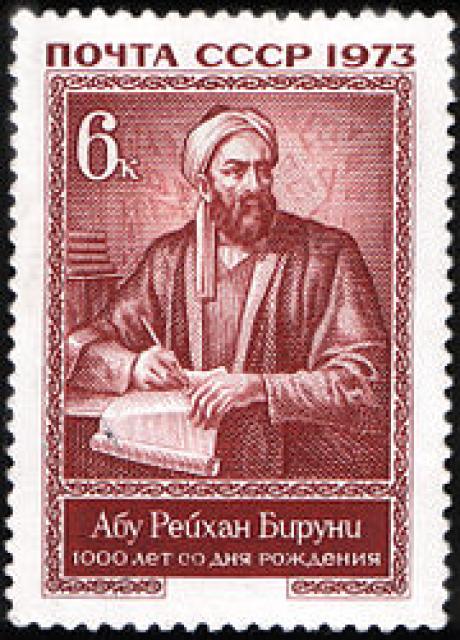
Abu Rayhan Muhammad ibn Ahmad al-Biruni, an illustrious Asian scholar of the medieval era, was born in the city of Kyat, the capital of the Khwarazm state, on September 4th, 973. Al-Biruni's early education commenced under the tutelage of the renowned astronomer and mathematician Ibn Iraq, encompassing not only mathematics but also philosophy. His thirst for knowledge led him to master nine Eastern languages, including Sanskrit and Hindi, as well as Greek and Latin.
Intellectual Contributions
Al-Biruni possessed an insatiable curiosity and delved into diverse fields of study. He excelled in history, geography, mathematics, astronomy, geodesy, philology, mineralogy, and pharmacology. His original research in these disciplines yielded 45 significant treatises. In his inaugural work on chronology, he meticulously analyzed calendar systems and compiled an extensive chronological table. His treatise on mineralogy meticulously described the properties of fifty metals, alloys, and minerals. His mathematical investigations were equally impressive.
Astronomical Discoveries
Al-Biruni's magnum opus, "The Canons of Mas'ud on Astronomy and Stars," showcased his groundbreaking astronomical contributions. He precisely calculated the Earth's radius, determined the angle of the ecliptic, described lunar eclipses with their distinctive color changes, and analyzed the character of the solar corona. His novel theory posited that stars and the sun were fiery in nature, unlike planets.
Travels and Intellectual Encounters
Al-Biruni embarked on extensive travels throughout the East, residing in India for several years as part of Sultan Mahmud of Ghazni's military campaign. This immersive experience culminated in a comprehensive treatise on Indian philosophical systems, including the Sankhya theory and cosmic evolution. Notably, this work featured the celebrated legend of the sage, the king, and the grains of wheat, which laid the foundation for the popular board games of chess and checkers.
Final Moments and Legacy
As Al-Biruni approached his end on December 9th, 1048, in the city of Ghazni, his mind remained sharp. Despite his feeble state, he engaged in scholarly discussions. In his final request to his friends, he inquired about methods of calculating dishonest profits. His unwavering pursuit of knowledge continued until his last breath, departing the world with the satisfaction of having extinguished his intellectual thirst.
Al-Biruni's extraordinary contributions to science and scholarship continue to inspire generations. His legacy as an intellectual titan of the medieval era endures, leaving an indelible mark on the advancement of human knowledge.