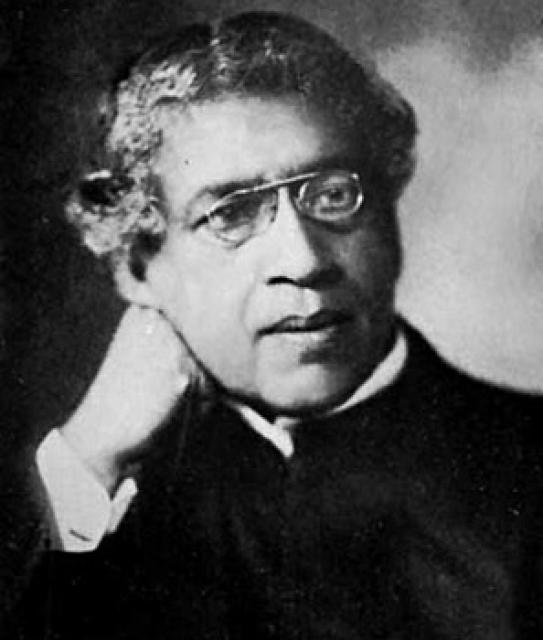
Jagadish Bose
 India
India- Biography of Jagadish Chandra Bose
- Early Life and Education
- Education in England and Return to India
- Contributions to Science
- Later Years and Legacy
Biography of Jagadish Chandra Bose
Jagadish Chandra Bose was a Bengali physicist, archaeologist, biologist, biophysicist, and science fiction writer. He was a pioneer in the study of radio and microwave optics and made significant contributions to plant science. Bose established several experimental science societies on the Indian subcontinent. The Institute of Electrical and Electronics Engineers (IEEE) named him as one of the creators of radio. Bose is also recognized as the father of Bengali science fiction. In 1904, he became the first Indian to receive a patent in the United States.

Early Life and Education
Jagadish Chandra Bose was born on November 30, 1858, in Bikrampur, Bengal (now in present-day Bangladesh). His father, Bhagawan Bose, was a leader of the religious society Brahmo Samaj and a deputy magistrate in Faridpur. Instead of sending his son to an English school, Bhagawan decided to steer clear of aristocratic influences. Jagadish initially attended a public school, where he heard interesting stories from classmates about birds, animals, and aquatic creatures. Bose acknowledges that this may have sparked his interest in understanding the wonders of Mother Nature. In 1869, Bose enrolled at Hare School and later attended St. Xavier's School. In 1875, he passed the University of Calcutta examination and was admitted to St. Xavier's College in Calcutta. His interest in the natural sciences was further fueled by his acquaintance with Jesuit priest Eugene Lafont. Jagadish obtained his Bachelor's degree in 1879.

Education in England and Return to India
Initially, Bose planned to go to England to become an Indian civil servant, but his father wished for him to become a worthy scholar and not be ruled by anyone but himself. Bose eventually arrived in England to study medicine at the University of London. However, his plans were disrupted by his poor health, which was adversely affected by the smell of dissected bodies in the anatomy labs. Undeterred, Bose enrolled at Christ's College, Cambridge, where he studied natural sciences. He passed the challenging Tripos exam at the University of Cambridge and graduated with a Bachelor of Science degree from the University of London in 1884.
Jagadish returned to India in 1885, where he was hired by Sir Alfred Croft, the Director of Public Instruction, at Presidency College upon the request of Lord Ripon. Bose served as a professor of physics, which was not favored by the college's principal, C. H. Tawney. However, Tawney had to accept Ripon's decision. When Bose felt unfairly treated, including receiving a low salary, he protested in a rather unconventional way. The scientist refused to accept his salary and worked for three years without pay. Eventually, both Croft and Tawney recognized Bose's teaching abilities and appreciated his nobility. Bose was appointed as a permanent professor at the college and received the funds owed to him for the three years. To conduct his experiments at the college, where there was no dedicated laboratory, Bose used the money he earned to purchase expensive equipment. For nearly ten years, he remained a pioneer in the field of wireless wave research.
Contributions to Science
In 1887, Bose married Abala, a renowned feminist and social worker. In 1894 or 1895, Bose demonstrated the "invisible light" or millimeter-wave microwave radiation in front of a large audience. He ignited gunpowder and rang a bell from a distance. His first scientific paper, "On polarisation of electric rays by double-refracting crystal," reached the Asiatic Society of Bengal in May 1895. Bose is considered the first person to use a semiconductor junction to detect radio waves and invent various microwave components still used today, such as antennas, polarizers, and waveguides.
Fascinated by plant physiology, Jagadish proposed the theory known as "life theory of ascent of sap" in 1927. With the help of a crescograph, he demonstrated that plants can possess a nervous system comparable to that of animals. By analyzing the nature of membrane potential changes in plant cells under different conditions, Bose concluded that plants can feel pain, develop attachments, and understand proximity, among other things.
Later Years and Legacy
Jagadish Chandra Bose passed away on November 23, 1937, in Giridih, British India. His pioneering work in the fields of wireless communication, microwave optics, and plant physiology laid the foundation for future scientific advancements. Bose's contributions to science and his devotion to understanding the mysteries of nature have left a lasting impact on the field of scientific research.


