Al-Mansur
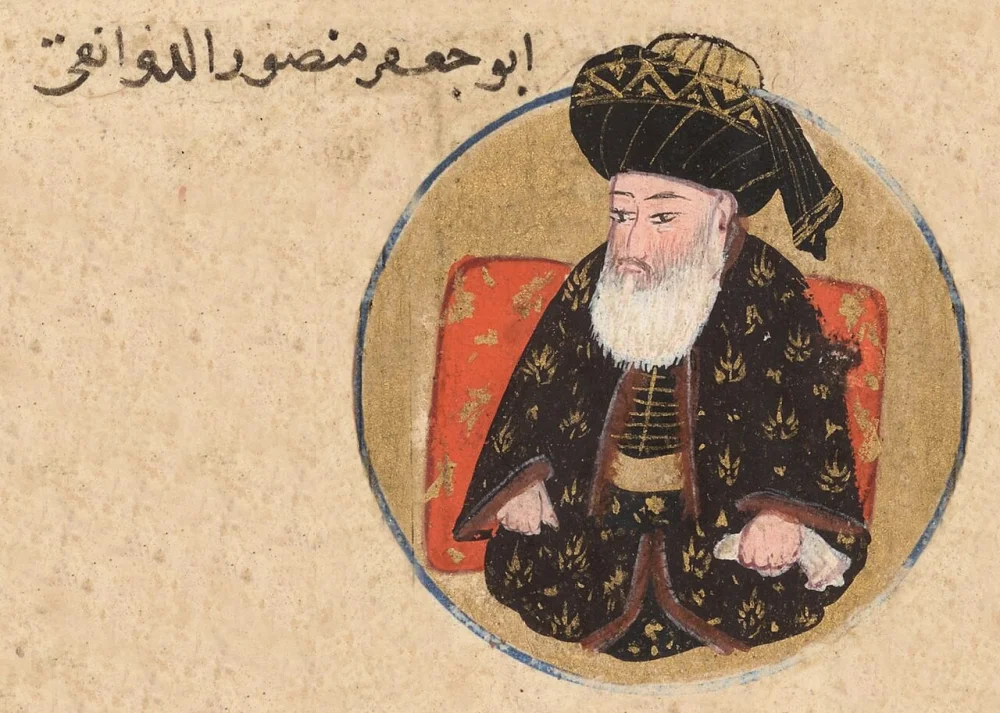
Al-Mansur was the second Abbasid caliph and the ruler who turned the dynasty’s early victory into a more durable state. A shrewd political strategist, he overcame rivals within the ruling family, brought powerful commanders under tighter control, and founded a new capital on the Tigris. The city he called Madinat al-Salam, “City of Peace,” became known as Baghdad and grew into one of the most influential centers of the medieval world.
A dynasty to consolidate
Born around 714 as Abd Allah ibn Muhammad, al-Mansur was a member of the Abbasid family, which traced its descent to al-Abbas, an uncle of the Prophet Muhammad. His brother al-Saffah became the first Abbasid caliph after the dynasty’s revolution toppled the Umayyads in 750. When al-Saffah died in 754, al-Mansur succeeded him at a moment when the new regime was still vulnerable.
His authority was challenged by his uncle Abd Allah ibn Ali, a powerful general who also claimed the caliphate. Al-Mansur relied on the general Abu Muslim, whose forces helped defeat the rebellion. Yet Abu Muslim’s popularity and independent power in Khurasan made him a potential rival. In 755, al-Mansur summoned and killed him. The decision secured the caliph’s control over the army and the eastern provinces, but it also made the new ruler’s willingness to remove even the dynasty’s most valuable allies unmistakable.
Building Baghdad
Al-Mansur’s most enduring achievement was the foundation of Baghdad. In 762, he chose a site near the Tigris and the old Persian capital of Ctesiphon, at a crossroads linking trade routes and major regions of the caliphate. The original city was laid out as a circular walled complex with gates facing the main roads. Its official name was Madinat al-Salam, though the older local name Baghdad prevailed.
The new capital was both a practical administrative center and a political statement. It placed the Abbasid court close to Iraq’s agricultural wealth and the networks connecting the Mediterranean world, Iran, and Central Asia. Al-Mansur supervised the project closely and attracted officials, soldiers, craftspeople, and merchants. Baghdad would expand far beyond the original Round City, becoming the dynasty’s principal seat and a hub of commerce and scholarship.
Rivals and revolts
Al-Mansur worked to strengthen the caliph’s authority through a more centralized administration, disciplined revenue collection, and careful selection of officials. His rule also faced repeated resistance. In 762, Muhammad al-Nafs al-Zakiyya, a descendant of Ali, led an uprising in Medina; his brother Ibrahim mounted a related revolt in Basra the following year. Al-Mansur’s forces defeated both movements. These conflicts reflected continuing disputes over who had the rightful claim to lead the Muslim community and over the authority of the new dynasty.
His government could be forceful and exacting, and later accounts often portray him as personally frugal and vigilant about state finances. Yet his political methods helped the Abbasids survive the unstable first years after their revolution. He prepared his son al-Mahdi to succeed him, establishing a dynastic transition that strengthened the new regime.
A lasting capital
Al-Mansur died in 775 while traveling on pilgrimage to Mecca. He left behind a state with a stronger central government and a capital whose importance would outlast the dynasty itself. Remembered as a founder and consolidator, he combined strategic calculation with ambitious building. Baghdad became the clearest monument to his reign: a city designed to anchor the Abbasid caliphate and connect its vast territories.