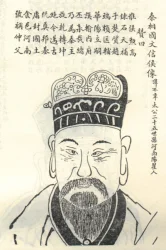
Al-Musta'sim
Al-Musta’sim bi’llah was the last Abbasid caliph to rule from Baghdad. He inherited a title that still carried immense religious and historical meaning, but the caliphate’s political and military power had contracted long before his reign. In 1258, Mongol armies under Hülegü captured Baghdad, ending the city’s Abbasid dynasty and killing its caliph. His reign is often told as a story of catastrophic failure, yet the fall of Baghdad also reflected decades of regional fragmentation and the overwhelming force of the Mongol expansion.
An Abbasid Caliph in a Changed Political World
Born Abd Allah ibn al-Mustansir, al-Musta’sim was the son of Caliph al-Mustansir, who ruled from 1226 to 1242. He succeeded his father in 1242. By then, the Abbasid caliphate was no longer the vast empire it had once been. The caliphs had re-established a degree of direct authority in Iraq, but their actual territory was centered on Baghdad and surrounding areas. Powerful neighboring states and military rulers controlled much of the wider Islamic world.
Al-Musta’sim’s role combined religious prestige with the difficult work of governing a vulnerable capital. He presided over a court and administration, issued appointments, and engaged with rulers beyond Iraq. But his ability to mobilize a broad coalition was limited. The Ayyubid rulers, the Seljuks of Rum, and other regional powers pursued their own interests, while the Mongol Empire steadily expanded westward.
The Mongol Threat
In the 1250s, the Mongol ruler Möngke dispatched his brother Hülegü to extend Mongol control across western Asia. Hülegü’s campaigns brought the destruction of the Nizari Ismaili strongholds in Iran and then turned toward Baghdad. The city’s defenses and the caliph’s military resources were not sufficient to meet this challenge. Diplomatic exchanges between the caliph and Hülegü failed to avert the invasion.
Mongol forces reached Baghdad in early 1258 and began a siege. The city capitulated in February after a short but devastating campaign. The conquerors killed large numbers of inhabitants, dismantled parts of the city, and ended Abbasid rule there. Contemporary accounts differ in detail and sometimes use dramatic figures or imagery. What is clear is that the capture caused enormous destruction and a profound rupture in the political and intellectual life of the region.
Al-Musta’sim was taken prisoner and killed after the city’s surrender. Medieval sources give differing accounts of how he died, and those stories were shaped by the political and religious perspectives of their authors. It is therefore more responsible to record the execution without treating one disputed version as certain.
A Contested Reputation
Later chroniclers often blamed the caliph’s vizier, Ibn al-Alqami, accusing him of weakening Baghdad or secretly collaborating with the Mongols. Modern historians approach these allegations cautiously. The accusations emerged amid factional and sectarian rivalries, and they cannot be treated as established fact. The fall of the capital is better understood through several causes: the caliphate’s limited resources, the fragmentation of regional powers, the failure to build a strong alliance, and the Mongol army’s superior ability to concentrate force.
Al-Musta’sim himself has often been portrayed as indecisive or negligent. The surviving record does not allow a simple judgment of his character, and accounts of his personal habits can repeat literary tropes rather than offer reliable evidence. His government did fail to protect Baghdad, but responsibility for the catastrophe extended beyond the choices of one ruler.
Legacy
The capture of Baghdad ended the Abbasid caliphate’s long rule in the city, which had begun in the eighth century. It did not erase the caliphal institution entirely: an Abbasid line was later established in Cairo under Mamluk patronage, where the title continued in a more ceremonial form. But the political world centered on Baghdad was irreversibly transformed.
Al-Musta’sim is remembered as the final caliph of Baghdad, a figure whose name became inseparable from the Mongol conquest. His reign marks both the end of a dynasty’s direct rule and the limits of a once-prestigious office in a region divided among competing states. The tragedy of 1258 was not simply the fate of one ruler; it was the destruction of a capital and the collapse of the political order that had surrounded it.