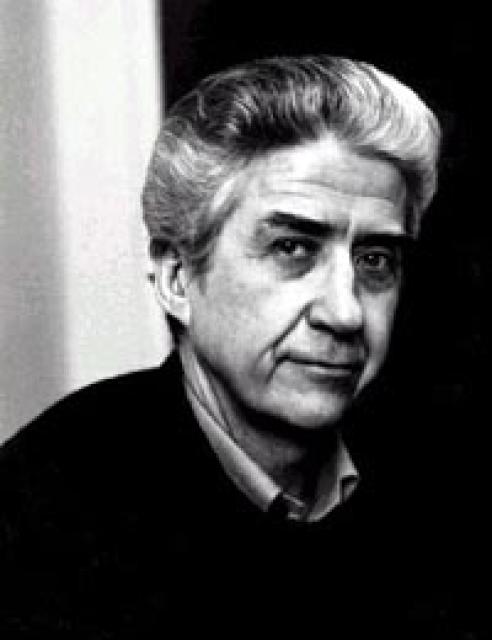
Alain Resnais
 France
Biography of Alain Resnais
Alain Resnais was a French filmmaker, born in Vannes, France. He was the son of a pharmacist and developed a passion for cinema at a young age. At the age of 14, he made his first amateur film "Fantomas" on 8mm film, but it wasn't until he was 20 years old that he decided to pursue a career in film.
Resnais studied acting at the R. Simon acting courses and attended directing courses at IDHEC (French Film School). In 1945, he was drafted into the army and served in a unit that entertained the Allied occupation forces in Germany and Austria. After being demobilized the following year, he started making short 16mm films, mostly silent documentaries but also occasionally dramatic ones. Some of his early works were shown on French television. He also worked as a cinematographer and editor on films by other directors during this formative period.
Resnais' career as a professional filmmaker truly began in 1948 with the release of his first 35mm short film, "Van Gogh," which won awards at the Venice Film Festival and an Oscar. He directed the film "Guernica" based on Picasso's painting in 1949, together with R. Essens. His film "Statues Also Die" (1952, with C. Marker) explored African art but was banned due to its anti-colonial themes.
Resnais' reputation grew with each short film he made, and it reached its peak with the release of the short film "Night and Fog," which depicted the world of Nazi concentration camps. This film showcased his inclination towards themes of memory and hinted at his future visual style. He continued to make documentaries, including "Gauguin" (1950), "All the Memory in the World" and "The Secret of the 15th Workshop" (1957), and "A Song for Styrol" (1958).
Resnais' exploration of memory and innovative storytelling techniques reached a new level in his first feature film, "Hiroshima Mon Amour" (1959). Inspired by the philosophy of Bergson and the literature of Proust, Resnais merged past, present, and future, creating a complex technique of retrospection to blend reality with memory.
His second film, "Last Year at Marienbad," manipulated time to create a narrative structure that lacked a traditional plot and had an ambiguous storyline. The film won the Grand Prix at the Venice Film Festival in 1961.
Following "Muriel, or The Time of Return," another complex exploration of audiovisual journeys into memory, Resnais directed "War Is Over" (1966), a more accessible film with an almost linear plot about the internal conflicts of an anti-Franco revolutionary. It won the Deluc Prize and several festival awards and achieved commercial success in many countries.
In 1967, Resnais participated in the creation of the essay film "Far from Vietnam," which criticized American militarism. He directed one episode for the film. However, his film "I Love You, I Love You" in 1968 was a commercial failure, which affected his career for several years. He returned with the film "Stavisky" (1974), a stylish biography of a French swindler, which was his most conventional narrative work to date.
Resnais' film "Providence" (1977), his first English-language film, pondered the creative process, examining the inner world of a cancer-stricken writer (John Gielgud) as he painfully works on a new novel. The film, considered perplexing and incomprehensible by some and brilliantly original by others, received a poor reception in the United States but won seven César Awards in France and gained wide recognition in Europe.
His next three films, "My American Uncle" (1980), "Life Is a Bed of Roses" (1983), and "Love unto Death" (1984), all written by Jean Gruault, formed an unofficial trilogy that united and summarized some of Resnais' philosophical, aesthetic, and ethical views, covering topics from love to theology.
Resnais was known for his impeccable mastery of form and is possibly the most significant director to emerge from the French New Wave movement. Although he always collaborated with screenwriters on his films, he is considered an auteur by critics, adhering to distinct themes and utilizing a highly personal technique he developed to address these themes. He was awarded the Grand Prix of French Cinema in 1976.
Some of his notable films include "Van Gogh" (1948), "Guernica" (1950), "Gauguin" (1951), "Statues Also Die" (1953), "All the Memory in the World" (1956), "A Song for Styrol" (1958), "Hiroshima Mon Amour" (1959), "Last Year at Marienbad" (1961), "War Is Over" (1966), "Life Is a Bed of Roses" (1983), and "Love unto Death" (1984).


