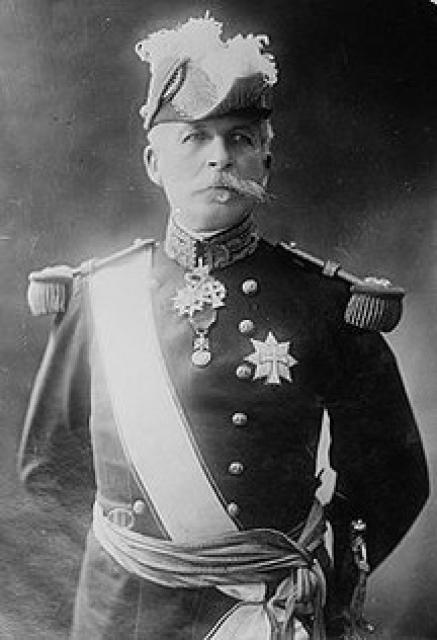
Albert Amade
 France
- Early Life and Education
- Military Career
- Overseas Service
- General Staff and Anglo-Boer War
- Command in Morocco
- Resignation and Reinstatement
- Later Commands
- World War I
- Dardanelles and Russia
- Later Life
Early Life and Education
A French Divisional General, he received his education at the École Spéciale Militaire de Saint-Cyr.
Military Career
He served in the Algerian troops and was transferred to the 3rd Regiment of Algerian Sharpshooters in Constantine in 1876. From 1881, he served in the 143rd Regiment and from 1885, in the 108th Infantry Regiment. In 1884, he became an ordnance officer under the Minister of War. He graduated from the École Supérieure de Guerre.
Overseas Service
He participated in the Tonkin Expedition in 1886 as an officer in the 2nd Brigade staff. From 1887 to 1891, he served as a military attaché in China. He then served in the 11th Infantry Regiment and commanded a battalion in the 18th Infantry Regiment.
General Staff and Anglo-Boer War
Transferred to the General Staff, he headed the English section of the 2nd Bureau (military intelligence). During the Anglo-Boer War from 1899 to 1902, he served with the Quartermaster General of the British Army. From 1901 to 1904, he was a military attaché in London.
Command in Morocco
In 1905, he was appointed commander of the 77th Regiment in Cholet. From 1907, he commanded a brigade in La Rochelle. From there, he was appointed commander of the expeditionary force in Morocco, replacing General Drude. He successfully led military operations in Chaouia in 1908, gaining a reputation as an energetic general. He supported an offensive and decisive approach against the Moroccans. However, he faced significant obstacles from the French government, which wanted to maintain a passive-defensive character for the French troops due to political reasons.
Resignation and Reinstatement
In 1909, he was dismissed after publicly expressing an unfavorable opinion on the Moroccan question that was critical of Spanish policy. However, he was soon reinstated as a Brigadier General.
Later Commands
From September 1909, he commanded the 9th Infantry Division in Orleans. On January 25, 1912, he became commander of the XIII Army Corps, and on June 18, 1912, he commanded the VI Army Corps. On April 25, 1914, he was admitted to the Supreme War Council.
World War I
At the start of the war on August 17, 1914, he led a group of four territorial divisions (60,000 men, 96 guns) operating in the zone of the 5th Army under General Charles Lanrezac. During the Battle of the Frontiers, his group occupied the area from Valenciennes to the coast and had the task of blocking the German cavalry. During the German advance, he quickly retreated, leaving Amiens uncontested. It is worth noting that the weak territorial troops commanded by Amade, which were composed of older conscripts and poorly armed, were unlikely to offer significant resistance to the opposing German forces. He was relieved of command by Joffre on September 27, 1914.
Dardanelles and Russia
On February 24, 1915, when the Dardanelles Operation was launched, Amade was appointed commander of the Eastern Expeditionary Corps, i.e., the French troops that formed part of General Ian Hamilton's Anglo-French Corps. The landing on the Gallipoli Peninsula was carried out on April 25, 1915. The operation was unsuccessful, and at the end of May, Amade returned to France due to illness (on May 14, 1915, General A. Gouraud was appointed in his place). In 1915, he was assigned to the military mission in Russia. In 1916, he became the Inspector General of the XIII, XIV, and XV Army Corps. From 1917 to 1919, he commanded the X Army Corps.
Later Life
From 1919, he retired. In 1925, he was awarded the Grand Cross of the Legion of Honour.


