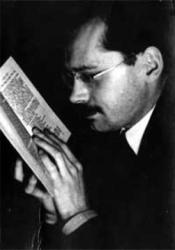
Aldo Capitini
 Italy
Italy- Early Life and Education
- Anti-Fascist Activism
- Resistance and Imprisonment
- Post-War Experiments and Pacifism
- Religious Reform and Controversy
- Later Career and Legacy
Early Life and Education
Born into a humble family in Perugia, Italy, Aldo Capitini began life as the son of a seamstress and a civil servant. Despite his delicate health that exempted him from military service in World War I, Capitini pursued education with zeal. While studying accountancy, he immersed himself in literature and philosophy, particularly fascinated by Mahatma Gandhi's ideas on nonviolence.
Anti-Fascist Activism
In 1924, Capitini earned a scholarship to study humanities at the prestigious Scuola Normale Superiore in Pisa. His unwavering beliefs in nonviolence led him to criticize the fascist regime and oppose the Lateran Accords between fascists and the Catholic Church. Consequently, Capitini was expelled from the school in 1930 after refusing to join the fascist party.
Resistance and Imprisonment
Undeterred, Capitini continued to disseminate his anti-fascist and pacifist ideas. In 1937, he published "Elementi di un'esperienza religiosa," which became a seminal text for the youth anti-fascist movement. Amidst the growing repression of opposition, Capitini was arrested twice, in 1942 and 1943.
Post-War Experiments and Pacifism
Following the war, Capitini unsucessfully ran for rector of the University for Foreigners in Perugia and was forced to resign under pressure from the Catholic Church. He subsequently founded the "Social Center" in Perugia, an experiment in direct democracy and decentralized power. Despite its influence, the initiative faced resistance from both the left and Christian Democrats.
Religious Reform and Controversy
Capitini's commitment to religious reform continued after the war. He established the "Religious Center" to foster dialogue beyond Catholicism, drawing the ire of the Catholic Church, which banned its members from attending. His 1955 book, "Religione Aperta," was condemned and placed on the Index of Forbidden Books.
Later Career and Legacy
Capitini organized the Italian Vegetarian Society and played a prominent role in the Association for the Development of State Schools in Italy. In 1964, he spearheaded the historic March for Peace and Brotherhood of Peoples, where the rainbow flag became a symbol of pacifism. Capitini's legacy lived on after his passing in 1968, leaving behind a profound impact on the anti-fascist, pacifist, and humanist movements.