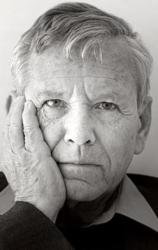
Aldous Leonard Huxley
 Great Britain
- Biography of Aldous Huxley
- Family Background and Education
- Recognition and Controversy
- Legacy and Final Years
- Correction made by Andrei (10.07.2006)
Biography of Aldous Huxley
Aldous Leonard Huxley, born in 1894, was an English writer. He faced a difficult fate from birth, being frail and having weak health and poor eyesight. His iconic thick glasses were often depicted in caricatures and cartoons. He had a habit of coming up with titles for his finished works, rather than the other way around. He struggled to find a suitable title for his new novel until he stumbled upon a line in Shakespeare's play "The Tempest" - "O brave new world..." - and found his inspiration.

Family Background and Education
Aldous Huxley came from a distinguished family. He was the grandson of Thomas Huxley, a renowned biologist, publicist, critic, and orator. Thomas Huxley was a fervent Darwinist and played a significant role in reviving the faith in the power of science in the 20th century. Despite his strong family background, Aldous Huxley chose not to pursue a scientific career and instead escaped into literature.
Recognition and Controversy
In the 1920s, Huxley gained recognition as an "anti-bourgeois" writer, and his works were highly valued and swiftly translated in the Soviet Union. His reputation allowed him to maintain the trust of the Soviet leadership until 1936 when two of his novels, "Antic Hay" and "Point Counter Point" (published as "Through the Colored Glasses"), were released in Russia. However, his most famous work, "Brave New World" (1932), did not fare well in Russia. It was fragmented and buried shortly after its release. The novel served as a dystopian warning about the potential consequences of a "consumer society," a term that did not exist at the time.
Legacy and Final Years
Aldous Huxley lived a full life but started to experience health issues early on. He suffered from incurable multiple sclerosis, and in his final years, he could only think and talk about euthanasia as a painless voluntary death. In his search for a way out, he experimented fearlessly on himself, believing in the existence of a third reality beyond life and art. It was during one of these experiments that he accidentally (or perhaps not) took a lethal dose of LSD.
In the year of Huxley's death (1963), the combined industrial output of the United States, England, France, Germany, and Japan equaled the total output of the rest of the world. The world had become divided into two parts: one with leaders and the other with consumers.
P.S. It should be noted that the article mentioned that Aldous Huxley "took a lethal dose of LSD," while in reality, he requested his wife to administer a regular effective dose (which was 5,000 times smaller than the lethal dose).