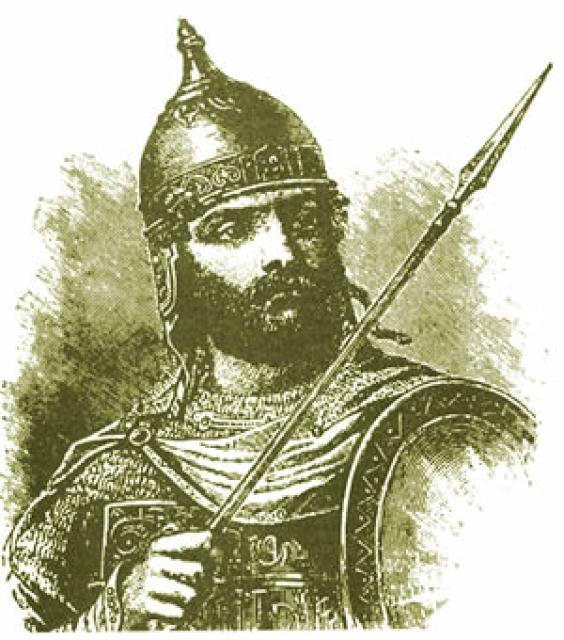
Aleksander Nevsky
 Russia
Alexander Nevsky - Russian Statesman and Military Leader
Alexander Nevsky, born in 1221 in Pereyaslavl-Zalessky, was a Russian statesman, military leader, and the prince of Novgorod. He is one of the most well-known figures in Russian history. Alexander, covered in military glory, received a literary narrative about his achievements shortly after his death and was canonized by the church. His name continued to inspire generations for many centuries. In 1725, the Order of St. Alexander Nevsky was established, followed by the Soviet Order of Alexander Nevsky in 1942, the only Soviet order named after a figure from the era of medieval Russia. For most Russians, his name is associated with the character portrayed by Nikolai Cherkasov in Sergei Eisenstein's film "Alexander Nevsky."
Biography
Alexander was born in 1221 in Pereyaslavl-Zalessky. His father, Prince Yaroslav Vsevolodovich, was the third son of one of the most powerful Russian princes of the late 12th and early 13th centuries, Vsevolod the Big Nest, son of Yuri Dolgoruky and grandson of Vladimir Monomakh. Yaroslav inherited the northeastern lands of Rus known as the Vladimir-Suzdal principality, while his older brother Yuri received the Vladimir-Suzdal lands. Alexander's mother was Rostislava-Feodosiya, the daughter of the Novgorod (later Galician) prince Mstislav Mstislavich. Alexander's older brother, Fedor, was born in 1213, and he was born in May 1221.
In 1230, Yaroslav Vsevolodovich established his rule in Novgorod after a difficult struggle against the Chernigov prince Mikhail Vsevolodovich, the grandson of Svyatoslav of Kiev. Yaroslav preferred to live in his native Pereyaslavl, leaving his sons Fedor and Alexander in Novgorod. In 1233, Alexander became the eldest of the Yaroslavich brothers after Fedor unexpectedly died at the age of 13. This sudden death occurred on the eve of his wedding, causing great grief among the people of Novgorod.
In 1236, Yaroslav Vsevolodovich left Novgorod and moved to Kiev, the nominal capital of all Rus. Alexander became the independent prince of Novgorod. It was during this time, in the winter of 1237-1238, that the Mongol Empire, led by Batu Khan, grandson of its founder Genghis Khan, ravaged the northeastern lands of Rus. They sacked 14 cities, including the capital, Vladimir. In a battle against one of the Mongol-Tatar units on the Sit River, Yaroslav's older brother, Grand Prince Yuri Vsevolodovich of Vladimir, was killed. After the Mongol forces returned to the Volga steppes in the spring of 1238, Yaroslav Vsevolodovich came from Kiev to the devastated Vladimir and took over the main princely seat of the northeastern lands of Rus. In 1239, he embarked on a campaign to strengthen his influence in neighboring lands. Yaroslav defeated the Lithuanian forces that had captured Smolensk and installed an allied prince there. He also successfully campaigned in southern Rus. As part of this policy, Yaroslav arranged for his eldest son to marry the daughter of the ruler of the important western Rus center, Polotsk. Alexander married the daughter of the Polotsk prince Bryachislav in 1239.
In the summer of 1240, an event occurred that brought Alexander his first military fame. Swedish feudal lords launched an invasion of the Finnish lands and captured the southwest part of Finland. Their continued advance eastward would inevitably lead to a clash with Novgorod, which controlled the mouth of the Neva River and the shores of Lake Ladoga. In 1240, a Swedish army entered the Neva River from the Gulf of Finland for the first time since 1164. They were possibly led by Jarl Ulf Fasi, the second most important title in Sweden after the king. It is unlikely that the Swedes' goal was to attack Novgorod itself; more likely, they aimed to strengthen their position at the mouth of the Neva to cut off Novgorod from the sea and prevent them from opposing the Swedes in the struggle for eastern Finland. The timing of the attack was fortunate for the Swedes, as the military forces of the northeastern Russian princes, who often came to Novgorod's aid in external wars, were weakened due to heavy losses suffered during Batu Khan's campaign in 1237-1238. Alexander's experience in previous military campaigns is unknown, but it is possible that he participated in his father's campaign against the German knights-crusaders in 1234. He may have also been involved in his father's actions against the Lithuanians in 1239. However, this was the first time he had to act independently, make decisions, and take command of military operations.
Instead of adopting a defensive position, Prince Alexander decided to attack the enemy immediately with only his own retinue and a small detachment of Novgorod residents. "Not by force, but by righteousness," the prince said as he set out on the campaign, according to the account of Alexander's Life. On July 15, 1240, a Russian army unexpectedly attacked the numerically superior Swedes, who were camped near the confluence of the Izhora River with the Neva. Caught by surprise, the enemy suffered heavy losses. The second-in-command of the Swedish forces and many noble warriors were killed. According to Alexander's Life, the prince personally engaged in combat with an enemy representative and wounded him with a spear to the face. The battle ended, presumably with the onset of darkness, and the Swedes had a chance to bury their dead. Under the cover of night, the remnants of the enemy army boarded their ships and sailed away.
In late 1240, German knights-crusaders launched an aggression against Novgorod. Since the late 12th century, the knights of the Sword Order had been seizing the lands of the Baltic tribes - the ancestors of Estonians and Latvians. The Order's possessions came into close proximity to the borders of Rus, along the Narva River and Lake Peipsi. Starting from the 1230s, direct clashes began to occur. After suffering defeats from Yaroslav Vsevolodovich in 1234 and particularly from the Lithuanians near Šiauliai in 1236 (where almost all the knights of the Sword Order - 49 people - were killed), the Sword Order merged with the Teutonic Order, which had settled in East Prussia (1237). The Teutonic Knights received reinforcements from Prussia and Germany, and the new united order came to be known as the Livonian Order. Unsatisfied with their conquests among the Baltic tribes, the crusaders attempted to expand onto Russian lands. Like their campaigns in the Eastern Baltic, the crusaders' actions were supported by the Papal See in Rome. The conquest of the Baltic peoples was justified by the idea of converting them to Christianity, while the war against Russia was justified by the fact that its people were considered "schismatics" from the Catholic point of view and adherents of the Eastern Orthodox version of Christianity. In late 1240, the Germans captured Izborsk, a city on the western border of Novgorod's territory. They then defeated the forces of the semi-autonomous center of Pskov and, with the subsequent collusion of some Pskov boyars, occupied the city. The Germans settled in Koporye, a pogost (a burial place and a stronghold for the local population) to the east of the Narova River near the Gulf of Finland. The entire western part of Novgorod's territories was ravaged by German troops. The situation was further complicated when in the winter of 1240-1241, Prince Alexander fell out with the Novgorod boyars and went to his father in Pereyaslavl with his retinue. The political structure of Novgorod had specific characteristics that differed from the structure of other Russian lands. The local boyars held significant power and invited princes from various lands to govern Novgorod at their discretion. Often, princes who failed to get along with the local nobility were forced to leave Novgorod. This happened to Alexander, although the exact reasons for the conflict are not mentioned in the sources.
Meanwhile, German troops were approaching the city, and the people of Novgorod sent an embassy to Yaroslav Vsevolodovich, requesting assistance. Yaroslav sent his second oldest son, Andrei, to help them. However, it soon became clear that Andrei could not organize a proper defense, and a new embassy was sent to Yaroslav, led by the Archbishop of Novgorod, requesting the return of Alexander to govern Novgorod once again. "And Yaroslav, his son Alexander again," the sources say.
Upon his return to Novgorod, Alexander actively took up the cause. In 1241, he launched an attack on Koporye, the stronghold of the invaders. The fortress built by the Germans was captured. Alexander brought some of the captured Germans to Novgorod and released the rest. He also ordered the hanging of the Finno-Ugric traitors who had sided with the enemy in the area surrounding Koporye. In early 1242, Alexander, along with his retinue, a Novgorod detachment, and a contingent led by his brother Andrei, sent by their father from Suzdal, marched into Livonian Order territory. He cut off the routes connecting the German possessions to Pskov and then launched a surprise attack, capturing the city. The Germans in Pskov were taken prisoner and sent to Novgorod. After crossing the border of the Livonian Order's territories, Alexander sent a reconnaissance detachment led by the Novgorod posadnik (the highest-ranking official in Novgorod from among the local boyars). This detachment encountered the Order's forces and engaged in battle. The leader of the detachment, Domash Tverdislavich, was killed in the battle, and some of the warriors were killed or captured, while others fled to Alexander. After that, the prince retreated to the ice of Lake Peipsi, the natural border between Novgorod's and the Order's possessions, and took a position on the eastern shore.
On April 5, 1242, a Saturday, the Order's forces attacked the Russians. Arranging themselves in a wedge formation (referred to as the "swine" formation in contemporary Russian sources), the Germans and their Estonian allies managed to break through the defensive line composed of lightly armed warriors. However, they were attacked from the flanks by cavalry units (presumably Alexander's and Andrei's retinues) and suffered a complete defeat. Alexander's warriors pursued the fleeing enemy for seven miles across the ice to the western shore of the lake.
According to the Novgorod Chronicle, the battle saw "the fall of countless Estonians," with 400 Germans killed. Additionally, 50 Germans were captured and brought to Novgorod. However, the Livonian source, the "Rhineland Chronicle," mentions different numbers of casualties: 20 knights killed and 6 captured. This discrepancy is likely due to the fact that the Russian source provides an approximate total number of German casualties, while the Livonian source only refers to the Order's knights. According to historians' calculations, there were only about a hundred knights in Livonia in 1242, and a significant portion of them were fighting the Baltic tribe of the Curonians. Therefore, the losses of 26 killed and captured probably amounted to about half of the number of knights who participated in the Battle on the Ice and about a quarter of the total number of knights in the Livonian Order.
In the same year, the Germans sent an embassy to Novgorod, requesting peace. The Order renounced all claims to Russian lands and requested an exchange of prisoners. A peace treaty was concluded.
While the war with the Livonian Order was taking place in Northern Rus, tragic events were unfolding in the South. In late 1240, Batu Khan's forces invaded Southern Rus, capturing Pereyaslavl, Chernihiv, Kyiv, Halych, Volodymyr-Volynskyi, and many other cities. After devastating the lands of Southern Rus, Batu moved towards Central Europe. Hungary and Poland were plundered by Mongol armies, and they reached as far as Bohemia and the Adriatic coast. It was only in late 1242 that Batu returned to the Volga region. The Golden Horde, a western ulus (appanage) of the Mongol Empire, was formed here. Batu recognized Yaroslav Vsevolodovich as the "senior" among the Russian princes, affirming his rights to Vladimir and Kyiv - the ancient capitals of Rus. However, the Golden Horde was still part of a vast empire that stretched from the Carpathians to the Pacific Ocean. In 1246, Yaroslav was forced to travel to the Mongol capital of Karakorum to seek approval and confirmation of his rule.
Alexander, meanwhile, continued to rule in Novgorod. In 1245, Novgorod's territory was raided by the Lithuanians, who reached Torzhok and Bezhichi. Alexander pursued them and defeated them in several battles at Toropets, Zhizhitsa, and Usvyaty (within the Smolensk and Vitebsk regions, respectively). In 1246, Yaroslav Vsevolodovich sent his second son, Andrey, to take over the defense of Pskov. However, Andrey proved to be ineffective in organizing resistance, and Alexander had to return to Pskov in his brother's place. In the same year, a peace agreement was concluded between Novgorod and the Livonian Order.
Alexander continued to play a significant role in Russian politics and military affairs until his death in 1263. He left a lasting legacy as a defender of Russia against foreign invaders and is remembered as one of Russia's greatest military leaders.


