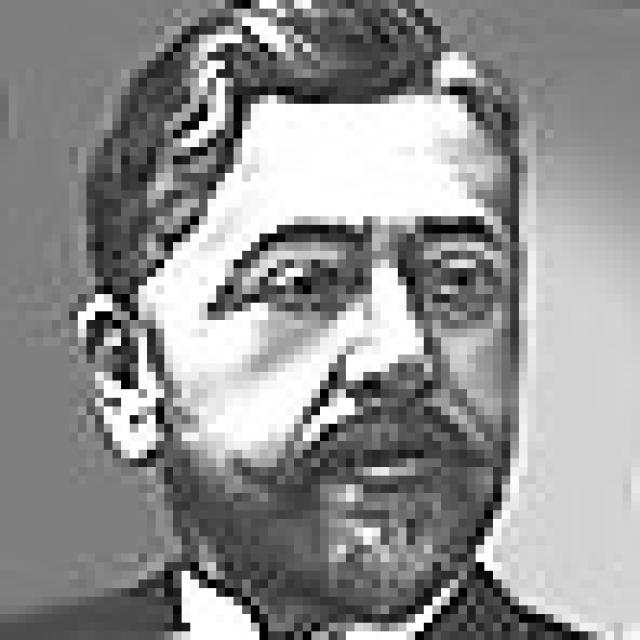
Alexandr Eiffel
 France
Biography of Alexandre Gustave Eiffel
Alexandre Gustave Eiffel was a French engineer, born in 1832. He was renowned for his construction of the Eiffel Tower in Paris, which became one of the most remarkable technical structures of the 19th century.
Career and Achievements
Throughout his career, Eiffel worked on various projects, including the construction of iron railways, bridges (such as the Bordeaux bridge and the D. Luis I Bridge in Porto, Portugal), viaducts, and train stations (including one in Budapest). He also designed the rotating dome of an observatory in Nice, which, despite weighing 100,000 kg, could be easily moved by a single person. Eiffel also contributed to the improvement of movable bridge systems.
Eiffel served as an engineer for the Panama Canal Company and supplied machines for the company from his engineering factory in Levallois-Perret, near Paris.
However, Eiffel's reputation suffered when revelations about the Panama Canal Company scandal emerged. He was accused of receiving 19 million francs from the company for fictitious work. In 1893, Eiffel, along with his father and son, as well as other individuals involved in the case, was sentenced to two years in prison and fined 20,000 francs. However, the appellate court later overturned the sentence due to the expiration of the statute of limitations.
Construction of the Eiffel Tower
Eiffel gained worldwide fame for his construction of the Eiffel Tower in Paris for the 1889 Exposition Universelle. The tower, standing at a height of 300 meters, was nearly twice as tall as the tallest buildings of the time, including the Great Pyramid of Giza (137 meters), Cologne Cathedral (156 meters), and Ulm Cathedral (161 meters).
The Eiffel Tower was made entirely of iron and consisted of three levels. The lower level formed a pyramid with four columns connected by an arched vault. The first platform was situated on top of this vault at a height of 57.63 meters. The second platform was another pyramid-shaped tower with four columns connected by a vault, located at a height of 115.73 meters. The third and final platform, at a height of 276.13 meters, consisted of four columns that gradually intertwined to form a colossal pyramidal column. Atop this column stood a lighthouse with a dome and a small platform at a height of 300 meters.
The tower was accessible via stairs with 1,792 steps or an elevator. The first platform housed several rooms for restaurants, while the second platform had water reservoirs for hydraulic elevators and a restaurant in a glass gallery. The third platform housed an astronomical and meteorological observatory, as well as a physics laboratory. The balconies of the three platforms offered a panoramic view of a 140-kilometer radius. The lighthouse illuminated an area within a 10-kilometer radius. The total weight of the tower was approximately 9 million kilograms, with 7.3 million kilograms consisting of iron parts.
The foundation of the Eiffel Tower was constructed from concrete masses. During storms, the tower's oscillations did not exceed 15 centimeters. The construction of the Eiffel Tower took place from January 28, 1887, to March 31, 1889, and cost 6.5 million francs.
In 1909, the Eiffel Tower became the property of the state, previously owned by a shareholders' company.
Overall, Alexandre Gustave Eiffel's contributions to engineering and his iconic creation of the Eiffel Tower have left a lasting legacy in the field of architecture and construction.


