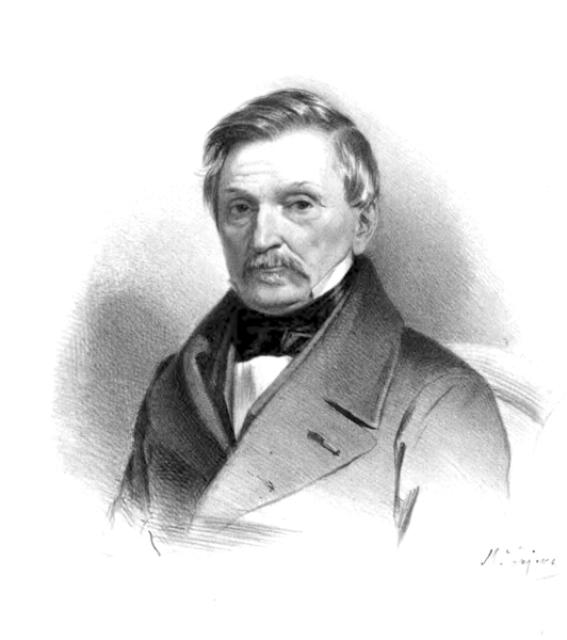
Alexandr Fredro
 Poland
- Alexander Fredro - Polish Dramatist and Politician
- Writing Career and Political Involvement
- Contribution to Literature and Legacy
- Personal Life and Family
Alexander Fredro - Polish Dramatist and Politician
Alexander Fredro was a Polish dramatist and politician, known for his comedy adaptations. He was born into a wealthy noble family and received his education at home, never attending public educational institutions. After the death of his mother in a fire at the family estate in 1806, he moved to Lviv with his father, Jacek Fredro.
In 1809, he joined the army of the Duchy of Warsaw and later served in Napoleon Bonaparte's forces. In 1812, he was awarded the Golden Cross "Virtuti Militari" for his participation in Napoleon's campaign to Moscow. In 1814, he was honored with the "Legion of Honor" cross.
Writing Career and Political Involvement
In 1818, Fredro created his first notable comedy, "Mr. Geldhab" (performed on stage from 1821). After his father's death in 1828, he inherited the family estate. In 1829, he joined the Society of Friends of Science. In 1846, after 18 years of living in the countryside, Fredro and his wife settled in Lviv. During the 1848 revolution in Galicia, he became a member of the Polish Lviv National Council.
From 1850 to 1855, Fredro lived in France. Starting from 1861, he served as a deputy of the Galician Regional Sejm and advocated for the construction of the first railway in Galicia. He also organized the Land Credit Society and the Galician Savings Bank.
Contribution to Literature and Legacy
Alexander Fredro was known for his comedies depicting the customs and life of the provincial nobility. He also wrote poetry, epics, and aphorisms. Although he belonged to the Romantic era, his style deviated from the typical romanticism, which was criticized by Severin Goshchinsky and Leszek Dunin-Borkowski. This criticism led Fredro to take an 18-year hiatus from literary work.
Building on the traditions of Enlightenment and theatrical practice, Fredro introduced new social and everyday content to the comedy genre, bringing the stage language closer to colloquial speech. His comedies played a significant role in the development of Polish realistic theater and are considered part of the golden fund of Polish literature. His fables have long been included in children's reading programs in Poland.
Fredro's plays are performed in theaters worldwide. His play "Ladies and Hussars" was successfully staged at the Eugene Vakhtangov Theater in 1960 (with a television adaptation in 1976).
Personal Life and Family
In 1828, Fredro married Countess Zofia Scarbek (formerly Jablonowska), whom he courted for 11 years. His son, Jan-Alexander Fredro, also became a playwright but remained relatively unknown. During the suppression of the Hungarian Revolution of 1848-1949, he went into hiding in France. His daughter, Sofia Ludwika Cecylia Konstancja (1837-1904), married Count Jan Kanty Remigian Sheptytsky in 1861. Their son, Roman Sheptytsky, would later become the Uniate Metropolitan Archbishop, Andrei Sheptytsky.


