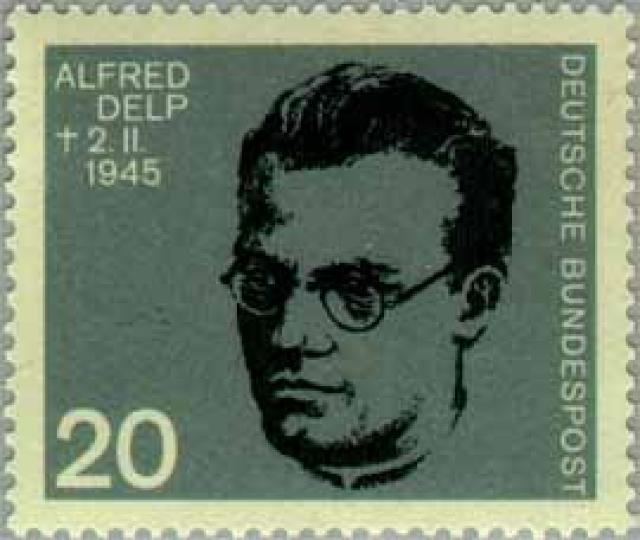
Alfred Delp
 Germany
Biography of Alfred Delp
German Catholic Priest and Resistance FighterAlfred Delp was a German Catholic priest, member of the Society of Jesus, and participant in the Resistance Movement in Germany. He was born to a Protestant father and a Catholic mother. Despite being baptized in the Catholic Church, he attended a Protestant school and underwent confirmation in a Lutheran Church in 1921. However, he soon converted to Catholicism, receiving his first communion and confirmation in the Catholic Church.
A Catholic priest who mentored him recognized his abilities and eagerness to learn and helped him enroll in the Goethe School in Diburg. Alongside his studies, Alfred participated in the Catholic youth movement "Union 'New Germany'". After completing his secondary education, he joined the Society of Jesus in 1926. Delp then studied philosophy in Pullach and worked as a prefect and physical education teacher at St. Blasien School in Schwarzwald.
After completing his theology studies in Valkenburg (Netherlands) and Frankfurt, he was ordained as a priest in Munich in 1937. Due to political motives, Delp was not allowed to work on his doctoral dissertation at the University of Munich. From 1939, he published in the Jesuit publication "Stimmen der Zeit," which was closed by the Nazis in April 1941. He was appointed rector of St. George's Church in Bodenhauser near Munich, where he secretly helped Jews fleeing Nazi Germany to Switzerland.
During the period of persecution of Jesuits by the Nazis, Alfred Delp served as a member of the anti-Nazi resistance group called the "Kreisau Circle," led by Helmuth James von Moltke. In 1942, Delp, along with other members of the group, worked on developing a new social model for post-war Germany, emphasizing the role of Catholic social doctrine within it.
After the failed assassination attempt on Hitler on July 20, 1944, Delp was arrested in Munich on July 28. Although he was not involved in the plot, it remains unclear whether he was aware of the assassination plans. He was held in Tegel Prison in Berlin, where he secretly celebrated Mass and wrote several sermons dedicated to Advent and Christmas, which were smuggled out of prison.
During his time in prison, the Gestapo offered Delp his freedom in exchange for leaving the Society of Jesus, but he refused. On January 9-11, 1945, Delp was sentenced to death for his involvement in the "Kreisau Circle" in a People's Court trial. On February 2, he was executed in Berlin's Plotzensee Prison.
In memory of Father Delp, several schools in Germany, including one in Bremerhaven, have been named after him. A Catholic student residence in Mannheim and a boarding house in the college town of Canisius College in Berlin also bear his name. In Diburg, a high school, a Catholic community center, and a street have been named after him. The German Armed Forces named a barracks in his honor, and a postage stamp was issued in the Federal Republic of Germany in remembrance of Father Delp.



