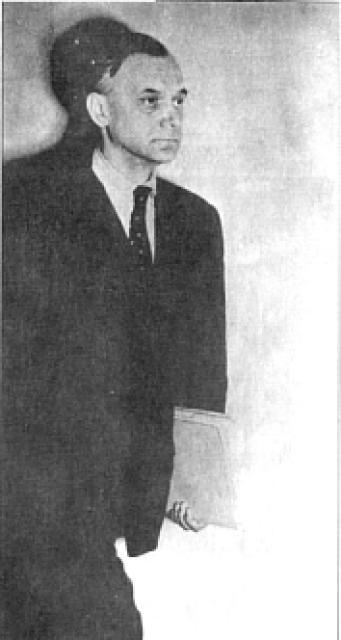
Alfred Rosenberg
 Germany
- Nazi Criminal and Ideologue: Alfred Rosenberg
- The Head of the Foreign Policy Department of the NSDAP
- The Five Major Governorates
- The Trial and Execution
Nazi Criminal and Ideologue: Alfred Rosenberg
Alfred Rosenberg was a Nazi criminal and the chief ideologue of Nazism. He served as Adolf Hitler's deputy for "spiritual and ideological preparation" of members of the Nazi Party and as the Reich Minister for the Occupied Eastern Territories. Born in Reval, he studied in Riga and Moscow, where he graduated from the Higher Technical School in 1918 with a degree in engineering and construction. His fluency in Russian would later contribute to his appointment as the Reich Minister for the Eastern Territories.

The Head of the Foreign Policy Department of the NSDAP
Starting from 1933, Rosenberg served as the head of the Foreign Policy Department of the NSDAP. Within this department, a special center for Eastern Territory affairs was established in April 1941. On April 20, 1941, Hitler informed Rosenberg of his decision to appoint him as the Minister for the Occupied Eastern Territories. On May 9, 1941, Rosenberg presented the Führer with a directive project regarding the policies to be implemented in the territories that would result from the aggression against the USSR. The project aimed to divide the Eastern Territories into five major governorates in order to prevent the resurgence of a strong Russian state.
The Five Major Governorates
The first governorate, called "Ostland," was intended to include Estonia, Latvia, Lithuania, and Belarus. This territory was designated for complete Germanization within two generations. The second governorate was to be Ukraine, which would incorporate Eastern Galicia, the Crimean Peninsula, territories along the Don and Volga rivers, as well as the Soviet Autonomous Republic of Volga Germans. According to Rosenberg, this governorate would provide a base for the Reich's struggle against the Russian people, while maintaining a certain level of autonomy.
The third governorate would encompass the territory of the Caucasus, separating Russia from the Black Sea. The oil-rich regions of the Caucasus would fall into German hands. The fourth governorate would be Russia itself, with its eastern borders depending on the progress of German forces beyond the Urals. The fifth governorate was to be Turkestan.
The Creation of the Reich Ministry for the Occupied Eastern Territories
After discussing this project, Hitler raised several objections. He reminded Rosenberg of Germany's policy failure in Ukraine in 1918 and opposed granting it autonomy. Hitler also rejected Rosenberg's proposed name of "governorate," suggesting it be replaced with "Reich Commissariat." On July 17, 1941, the Reich Ministry for the Occupied Eastern Territories was established, with Rosenberg appointed as its leader.
The Trial and Execution
Following the verdict of the International Military Tribunal in Nuremberg, Rosenberg was executed on October 16, 1946. He was the author of books such as "The Future Path of German Foreign Policy" (1927) and "The Myth of the Twentieth Century" (1929).


