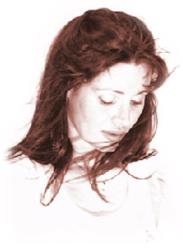
Alla Gorbacheva
 Ukraine
Biography of Alla Gorbacheva
Alla Gorbacheva was born in a small provincial town near Donetsk. She inherited her love for singing and her beautiful voice from her grandfather, a Don Cossack. In her childhood, she enjoyed playing energetic games and climbing fences with the boys, but she didn't cause much trouble for her parents. It was during her early years that she discovered her love for singing. "I would walk to kindergarten singing along the way, and even then passersby predicted a great future for me," she recalls.
At the age of 14, while still in school, Alla began professionally singing at a youth café. She won multiple youth music competitions and caught the attention of producer Sergey Obukhov, who saw great potential in her talent. "I was introduced to Alla's music through an audio cassette that my friends brought back from their tour in Ukraine," Sergey remembers. "For months, I debated whether or not to launch this project. I felt that there were very few singers in Russia who could perform live for two hours, truly showcasing their vocal abilities. Our music industry has been flooded with satire and gimmicks, and the quality of songwriting has declined. I wanted an artist who could either entertain through satire or rely solely on their voice. Among my proteges, the duet 'Hochu!' specializes in satire, 'Zabyty razgovor' focuses on melodies, and I hope Alla Gorbacheva will represent the voice of Russia, the Slavic soul."
With this opportunity, Alla's career on the big stage began. In the same year, she recorded her debut album, "Ya pridu" (I Will Come), featuring two music videos for the songs "Proshchai" (Goodbye) and "Napishi" (Write). Notably, the album included songs written by renowned composers such as Sergey Trofimov and Oleg Molchanov, as well as two songs written by Alla herself. Before the album's release, some of its songs were featured in compilations by the "Soyuz" studio, which introduced the public to Alla's remarkable talent.
Her debut album consisted of 12 songs, all of which were deeply lyrical, warm, and romantic. Even the dance tracks, such as "Gde-to ryadom" (Somewhere Nearby) and "Napishi" (Write), carried a personal and emotional touch. The music resonated within the listeners, reaching their hearts. The album's lyrics stood out from the crowd, offering depth and meaning, even in the dance compositions. Alla already had a good foundation for success, thanks to her name and captivating voice. Who wouldn't be intrigued by a newcomer named Alla Gorbacheva, sharing the same name as the iconic Russian singer Alla Pugacheva and the surname of the world-renowned Soviet political reformer, Mikhail Gorbachev? Moreover, Alla's voice and artistry lived up to the high standard set by her legendary namesake. With the right promotion, she had the potential to revolutionize the Russian music scene, just as her famous namesake had done in the political arena.
However, in 1997, there was almost no promotion for her debut album. Nevertheless, it was warmly received by listeners, especially by audio product retailers. For the first month and a half after its release, Alla's songs could be heard everywhere. The Russian audience, craving strong and emotional female vocals, finally found hope in her music. Her refreshing sound burst into the musical landscape of the country. The following year, she released two albums. After the release of the album "Golos" (Voice), it received numerous rave reviews in the press and on the internet. The album also featured a brilliant rendition of Toni Braxton's song "Unbreak My Heart" titled "Serdtse, ne plach" (Heart, Don't Cry). Alla's interesting and powerful vocals allowed her to play various roles in her songs, from a young girl to a mature woman. "This singer has great expressive abilities in her voice, many different personas... That's why we decided to call the album theatrically 'Golos' (Voice)," says the producer.
In the same year, she released the album "Ne grusti" (Don't Be Sad) and filmed three music videos for the songs "Mama" (Mother), "Serdtse, ne plach" (Heart, Don't Cry), and "Ne grusti" (Don't Be Sad). However, during the release of this album, the producer faced significant financial difficulties due to the economic crisis in August, leading to the near disappearance of the audio product market. Nonetheless, the album "Ne grusti" saw the light of day towards the end of 1998. Also, in the same year, Alla successfully participated in the revived competition "Jurmala 98" and won the Grand Prix. In 1999, she released a compilation album titled "The Best," featuring her greatest hits. The album also included two new songs, "Milenkii ty moi" (My Sweetheart) and "Lin Li Lo" (I'm With You) (I haven't had the chance to listen to this compilation, as I consider other songs to be the best).
Her next album, "Zhal" (Sorry), was released in January 2000. A music video was filmed for the title track, making it her sixth music video. While working on this album, the producer decided to change the creative team and brought composer and arranger Denis Maloy and lyricist Tamara Ananieva on board. Dmitry Postovalov contributed several arrangements to the album. Compared to her previous albums, "Zhal" had a slight shift towards dance songs that were not meant to be listened to closely for their lyrics. In the same year, Alla's first solo television concert was aired as part of the project "Nasha muzyka" (Our Music). For the concert, the producer invited the jazz ballet group "Victoria," with whom Alla continues to perform to this day. She also successfully embarked on her first international tour in Germany and a summer tour along the Black Sea coast.
In March 2001, Alla released the album "Bessame mucho" (Kiss Me a Lot) with songs like "Bessame mucho" (original & remake), "He novezlo" (He's Lucky), and "Pyat' chasov na ulitse" (Five Hours on the Street), which were immediately picked up by over 300 radio stations in CIS countries and neighboring countries. Even the reluctant "Russkoe radio" began to play Alla's songs. This album dispelled any concerns I had after the previous album's release, as all the songs were romantic and meaningful.
The album was produced by Denis Maloy, who also served as the composer, arranger, and sound producer. Most of the lyrics were written by Tamara Ananieva. Only two songs, "Den i Noch" (Day and Night) by O. Valyando and "Ya po tebe skuchayu ochen" (I Miss You So Much) by N. Lapteva, deviated from the pattern. During the production of this album, producer Sergey Obukhov decided to forgo involving external composers and lyricists. He believed that having different authors would make it difficult to create and showcase his own style, compromising the album's stylistic unity (although, in my opinion, the first three albums had successfully achieved that).
Unfortunately, Alla's level of recognition is currently insufficient for such a talented and remarkable singer. Her name is unknown to many, and little is known about her current projects.