Anatoliy Bichukov
 Russia
- Early Life and Education
- Artistic Journey and Notable Works
- Academic and Social Engagements
- Recognition and Legacy
Early Life and Education
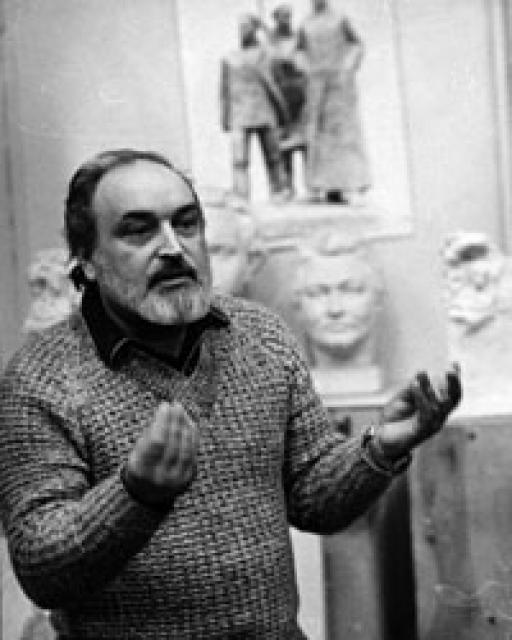
Anatoly Alexeyevich Bichukov was born on May 24, 1934, in Donetsk, Ukraine. Inspired by his artistic inclinations, he pursued his art education at the Art and Decoration College in 1949 under the guidance of sculptor V.I. Pukhalsky. After graduating in 1951, he was dispatched to Moscow as a facade-molder for the construction of a building on Frunzenskaya Embankment.
In 1953, Bichukov was drafted into the Soviet Army. Upon his demobilization, he returned to Moscow and worked as a graphic artist for various publications, including "Literaturnaya Zhizny," "Krasnaya Zvezda," and "Meditsinskaya Gazeta." Simultaneously, he attended classes at the Central Art School in sculpture and, in 1959, enrolled at the Surikov Moscow State Art Institute in the sculpture faculty, studying under M.G. Manizer and L.E. Kerbel.
Artistic Journey and Notable Works
Bichukov became a member of the Union of Artists in 1967. He participated in numerous competitions and exhibitions and was particularly celebrated for his sculptural masterpieces that became integral to Moscow's urban landscape. Among his most renowned works are monuments to famous personalities such as I. Botkin, aviation heroes at Vnukovo Airport, and the "Defenders of the Russian Land" on Poklonnaya Hill. Bichukov also created the memorial for Sergei Yesenin on Tverskoy Boulevard and his tombstone in the Vagankovsky cemetery.
Beyond the capital, Bichukov's creations can be found in various locations. He sculpted the "Saint George" statue on Trubnaya Square, which serves as the symbol and prize of the Moscow International Film Festival. He also crafted monuments to A.S. Pushkin in Santiago, Chile, and Almaty, Kazakhstan, and G.K. Zhukov in Odintsovo, Moscow Oblast.
Bichukov's artistic versatility extended to religious structures as well. He designed and built a chapel in honor of the Kazan Icon of the Mother of God in Moscow. His talent is also evident in the numerous monuments he created for the city of Semenov in the Nizhny Novgorod region, including tributes to B. Kornilov, victims of the revolution, and the founder of Khokhloma folk art, Matveev.
Academic and Social Engagements
Since 1988, Bichukov has been a professor and head of the sculpture department at the Russian Academy of Painting, Sculpture, and Architecture. He has actively participated in national and international exhibitions, earning prestigious awards and recognition for his artistic achievements. His sculptures adorn Russian and foreign museums alike.
Bichukov's contributions extended beyond the realm of art to the restoration of Moscow's landmark Church of Christ the Savior. He also played a role in creating allegorical figures representing Russia and Justice, as well as portraits of Russian emperors, for the Russian President's apartments in the Moscow Kremlin.
Recognition and Legacy
Anatoly Alexeyevich Bichukov received numerous honors and distinctions throughout his career, including the title of People's Artist of Russia (1981), Honored Artist of Russia (1980), and Laureate of the International Prize of United Europe. He was awarded the Order of Honor, the Medal of the Order "For Merit to the Fatherland" (Second Class), and the Order of St. Sergius of Radonezh from the Russian Orthodox Church.
Bichukov's dedication to both art and education has earned him the respect and admiration of his peers. As the rector of the Surikov Moscow State Academic Art Institute, he continues to foster the growth of young artists. His contributions to the preservation and advancement of Russian art have left an enduring legacy in the cultural landscape.