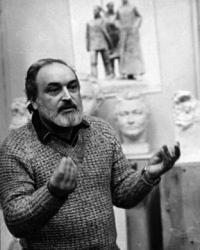
Yakov Agam
 Israel
- Yaakov Agam: Pioneer of Kinetic Art
- Influential Factors
- Distinctive Style
- Metamorphosis and Visual Illusions
- "Plastic Themes" and Viewer Interaction
- Monumental Commissions
Yaakov Agam: Pioneer of Kinetic Art
Early Life and EducationBorn on May 11, 1928, in Rishon Lezion, Palestine, Yaakov Agam, originally named Yaakov Гипштейн, came from a religious background. His youth was marked by traditional Jewish education, followed by studies at the "Bezalel" School of Arts in Jerusalem (1947-1948). He later pursued art education in Zurich (1949-1951) and Paris (1951), ultimately settling in the French capital.
Influential Factors
Influenced by Kabbalistic symbolism, Agam rejected the passivity of contemporary art, seeking a more active and immersive experience for the viewer.
Distinctive Style
Agam deviated from the geometric and industrial aesthetics common in kineticism. He embraced handcrafted forms and rhythms, particularly in his "jalousie" works. These sculptures resembled blinds, perpetually shifting their non-figurative patterns.
Metamorphosis and Visual Illusions
In his early works, Agam incorporated visual illusions and op-art aesthetics. His "Metamorphosis" series, executed in oil on aluminum, exemplifies this approach. Similarly, "Double Metamorphosis" (1965) and other works employed illusionistic effects on flat surfaces or in reliefs, such as the "metapolymorphic" "Vision" (1965-1966).
"Plastic Themes" and Viewer Interaction
As Agam's practice matured, he increasingly introduced interactive elements into his "plastic themes." These works relied on the viewer's manual, mechanical, or digital participation to manipulate their forms and generate dynamic experiences.
Monumental Commissions
Recognized as an authoritative figure in Israeli art, Agam received numerous prestigious public commissions. His kinetic sculpture "Thousand Gates" adorned the presidential palace in Jerusalem (1972), while his monumental musical fountain in Paris' La Défense neighborhood (1975) became a celebrated landmark.