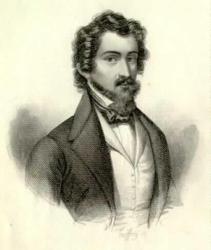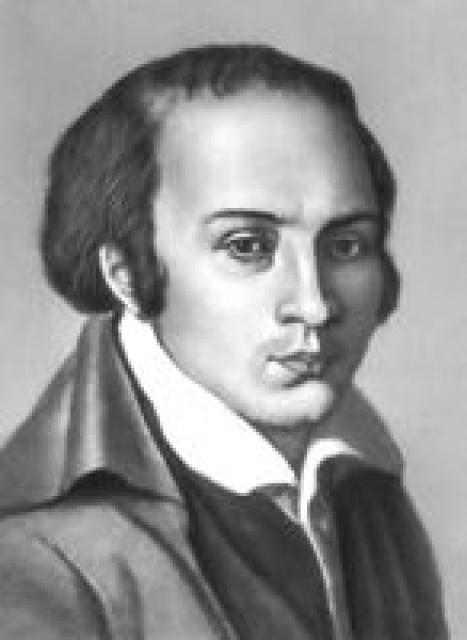
Andre Chenier
 France
Andre Chenier: A Romantic Figure and Poet
Andre Chenier, a French poet and publicist, was born in Constantinople to a wealthy French merchant. By the time of the revolution, he was no longer a boy but a man of 27 years old, a mature age for that time. Chenier, along with his three brothers, pursued similar careers. Constant and Mari-Joseph were writers, while Andre became a poet and journalist, and Sover served as an officer. The tumultuous events of the French Revolution both separated and reunited the Chenier brothers, disrupting their peaceful and privileged lives.
A Voice for Liberalism
Starting in 1790, as the initial exuberance over national unity faded and the revolution entered a period of social unrest, Chenier tirelessly expressed his liberal views in numerous newspapers and publications. He was skeptical of the power of the "Majesty of the People" and feared that the tyranny of the masses and demagogic leaders would be worse than the tyranny of the Bourbons. He reminded his readers of the five prisoners found in the destroyed Bastille, three of whom were content with their lives and did not desire freedom, one was insane, and only one rejoiced at his newfound liberty but was accidentally trampled by the crowd of liberators carrying him on their shoulders.
A Martyr of Freedom
Chenier's name appeared on the proscription lists of "enemies and suspects" since July 1792. With the establishment of the Jacobin Republic in late September 1792, he was forced into hiding. Learning about the trial of the king by the Convention, which began in December 1792, Chenier published a series of articles in the journal "French Mercury," arguing that the status of the Convention and the Constitution did not allow for the trial of the king but only for his removal from power. These articles became a death sentence for Chenier himself.
A Tragic End
Chenier had the option to remain in Versailles, where he had friends and patrons. However, in the summer of 1794, he appeared in Paris, where he was immediately arrested and sent to the Saint-Lazare prison. He was then falsely accused of a "prison conspiracy" and subjected to a two-minute trial. Andre Chenier was guillotined on July 25, 1794, two days before the Thermidorian Revolution and the fall of Robespierre's dictatorship.
Could he have survived? It is unlikely. On the night of July 28, after the revolution, 80 people were inadvertently executed in the prisons of the Conciergerie and Saint-Lazare.