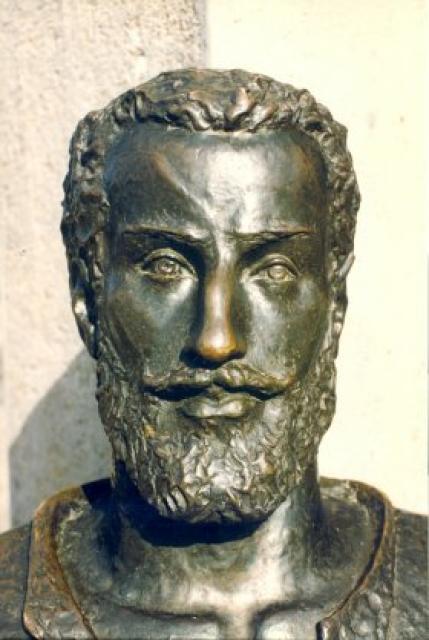
Luis de Camoes
 Portugal
- Luís de Camões: The National Poet of Portugal
- The Court Years and Exile
- Military Service and Travels
- Life in India and Return to Portugal
- Legacy and Final Days
Luís de Camões: The National Poet of Portugal
Early Life and EducationLuís Vaz de Camões, considered the greatest Portuguese poet of the Renaissance period, was born in 1524, most likely in Lisbon. His exact birthplace and the date of his birth remain subject to debate. Camões's ancestors were distinguished individuals, including his father, who was a sea captain, and his maternal grandfather, who was related to the famous explorer Vasco da Gama.
At a young age, Camões studied in a monastery school in Coimbra. Later, he enrolled in the prestigious University of Coimbra from 1537 to 1542, where he excelled in languages and literature. Influenced by the works of Spanish writer Sá de Miranda, Camões began writing poetry during his university years.
The Court Years and Exile
After leaving university without a degree, Camões moved to Lisbon in search of opportunities. He found employment as a tutor in the household of Count of Noroña. In 1544, he met and fell deeply in love with Catarina de Ataíde, a lady-in-waiting to the queen.
Camões's love for Ataíde led to conflicts with her family and rivals. In 1549, he was banished from Lisbon by royal decree due to alleged involvement in a quarrel. However, some scholars dispute this widely held version of events.
Military Service and Travels
Faced with court intrigues or financial difficulties, Camões joined the military and served in North Africa. In battle, he lost his right eye. After two years of service, he returned to Lisbon in 1551.
A violent incident in 1552 resulted in Camões's imprisonment and subsequent exile to India in 1553. During his journey to India, it is believed that he penned the first cantos of his epic poem, "The Lusiads."
Life in India and Return to Portugal
In India, Camões fought in various battles, wrote poetry, and traveled extensively. He also staged plays and held administrative positions. In 1561, he received news of Ataíde's death, which deeply affected him.
Despite completing "The Lusiads" in India, Camões faced false accusations and was exiled to Macau. During his return journey to India, his ship was shipwrecked, and he managed to save the manuscript of "The Lusiads."
Legacy and Final Days
In 1567, Camões left India and eventually returned to Portugal in 1569 or 1570. He presented "The Lusiads" to King Sebastian, who granted him a small pension. Despite the poem's acclaim, Camões lived in poverty and witnessed the loss of Portuguese independence.
Luís de Camões died on June 10, 1580, from the plague. He was buried in the church of St. Anne. His death marked the loss of one of the most revered literary figures in Portuguese history. "The Lusiads," a masterpiece of world literature, has earned Camões his place as the national poet of Portugal and one of the greatest literary icons of the Renaissance era.


