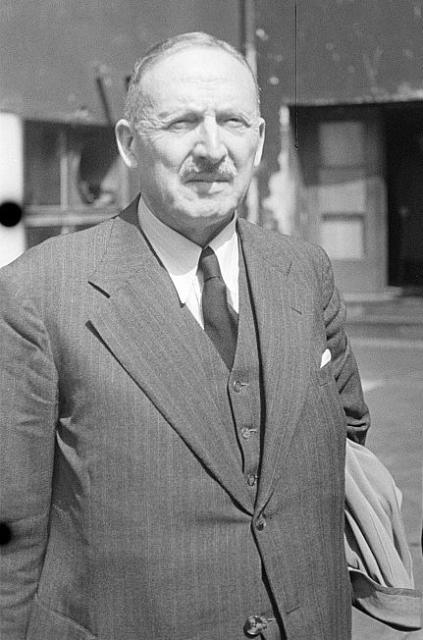
Andreas Hermes
 Germany
- Andreas Hermes: German Scientist and Statesman
- Pre-War Career
- Political Career during the Weimar Republic
- Resistance to Nazism
- Return to Germany and Involvement in the Resistance
- Execution Sentence and Survival
- Post-War Political Activity
- Later Career
Andreas Hermes: German Scientist and Statesman
Early Life and EducationAndreas Hermes, born in Cologne, Germany, embarked on a path of intellectual pursuits by studying agriculture and philosophy at the universities of Bonn, Jena, and Berlin. His academic journey culminated in a doctoral dissertation on "Optimization of Crop Rotation" at the University of Jena in 1906.
Pre-War Career
Prior to and during World War I, Hermes held various scientific and advisory roles within the agricultural sector. His expertise led him to be appointed to the Reich Ministry of Economics in Berlin in 1919.
Political Career during the Weimar Republic
Hermes' political career flourished during the Weimar Republic. In 1920, he was appointed as the nation's Minister of Food, and from October 1921 to August 1923, he concurrently led the Ministry of Finance. Following his tenure as a member of the Prussian Parliament from 1924 to 1928, he entered the Reichstag as a representative of the Centrist Party.
Resistance to Nazism
With the rise of the Nazis to power, Hermes became an outspoken critic. His opposition led to his imprisonment for four months. In 1936, he was forced into exile in Colombia, where he remained separated from his family until the outbreak of World War II.
Return to Germany and Involvement in the Resistance
Despite his exile, Hermes maintained close ties with Karl Gördeler and other members of the "Kreisau Circle" resistance movement. He was designated to be Minister of Agriculture in the event of a successful coup.
Execution Sentence and Survival
On January 11, 1945, Hermes was sentenced to death by the People's Court, but thanks to his wife's efforts, the sentence was postponed. The end of the war soon followed, allowing him to escape execution.
Post-War Political Activity
In the aftermath of the war, Hermes played an instrumental role in establishing the Christian Democratic Union in the Soviet-occupied zone of Germany. He served in its leadership but faced opposition from the military administration, prompting him to move to the West in Bonn.
Later Career
From 1947 to 1948, Hermes was a member of the Economic Council and chaired the Food Committee. He held the presidency of the German Farmers' Association from 1948 to 1954, continuing his dedicated service to the agricultural sector until his passing.


