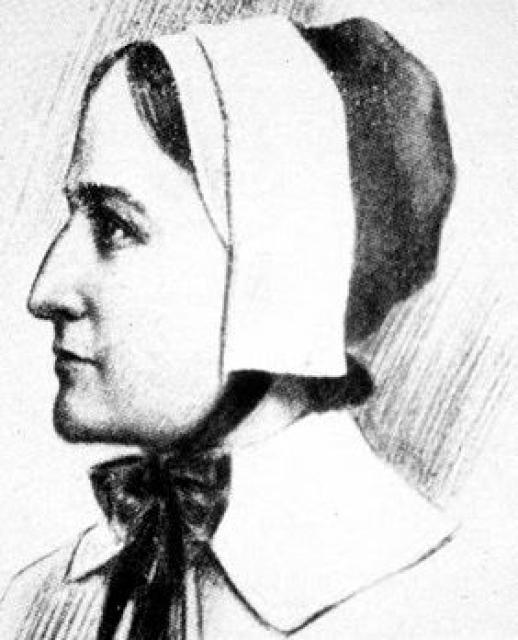
Anne Hutchinson
 USA
USA- Biography of Anne Hutchinson
- Religious Influences
- Life in Boston
- Trial and Exile
- Life in Exile and Tragic End
Biography of Anne Hutchinson
Early Life and EducationAnne Hutchinson, an American religious figure, was born as Anne Marbury in Alford, Lincolnshire, England, to Francis Marbury and Bridget Dryden. Her father was an Anglican minister who believed in providing education to his congregation, which often caused conflicts with higher authorities. Anne was the third of fifteen children, and she received a better education than most girls of her time due to her father's teachings and her exposure to the Scriptures and Christian doctrines.
Religious Influences
After her father's death, Anne married William Hutchinson and moved to Alford. It was there that she first heard about John Cotton, a well-known preacher, and his speeches greatly influenced her religious beliefs. Another preacher, John Wheelwright, also played a significant role in shaping her religious views. While Cotton's teachings did not entirely align with the Puritan Church, Wheelwright's sermons led them to be noticed by Archbishop William Laud, who actively fought against various heresies. As a result, John was forced to flee the country, and Anne, along with her husband, 11 children, and mother-in-law, followed him to America.
Life in Boston
The Hutchinsons settled in Boston in 1634, and William began trading in clothing with success. Anne became a respected mentor to other women, particularly in matters of childbirth. She formed a women's study group that actively discussed the Bible. However, Anne's views started to diverge from the Puritan Church, especially in her interpretation of the Adam and Eve story and the doctrine of original sin. Her dissent attracted the attention of other clergy members, but it was not until 1636 that she caught the attention of John Cotton.
Trial and Exile
In November 1637, Anne Hutchinson stood before a court accused of heresy. Despite being heavily pregnant at the time, she was forced to stand for hours before the interrogators. However, Anne displayed wit and eloquence during the trial. John Cotton, who was also one of the accused, defended her. He skillfully demonstrated that the initial accusations were far from the truth. Nevertheless, the court feared setting her free, as they believed her example could inspire other women. On the second day of the trial, Anne realized that rhetoric could not save her, and in a fit of anger, she cursed the elders in the courtroom. This outburst only strengthened the accusations against her, and she was deemed a heretic and sentenced to exile.
Life in Exile and Tragic End
Anne and her supporters had already left the colony prior to the trial, and they settled on Aquidneck Island. In May 1638, Anne, who had endured immense strain in recent months, fell ill. Her pregnancy ended tragically with the birth of a deformed mass, caused by a rare condition called "blighted ovum." Many of Anne's opponents saw this as a punishment from God, but it did not break her spirit. Disorder ensued in the colony they left behind, but it was eventually suppressed, leading some settlers to establish their own colonies, including Portsmouth and Newport. Anne later found a new home on Dutch territory. Unfortunately, this choice proved ill-fated as conflict with Native Americans arose. During a raid, Anne and members of her family were scalped by the Sivanoy tribe, resulting in their tragic deaths.


