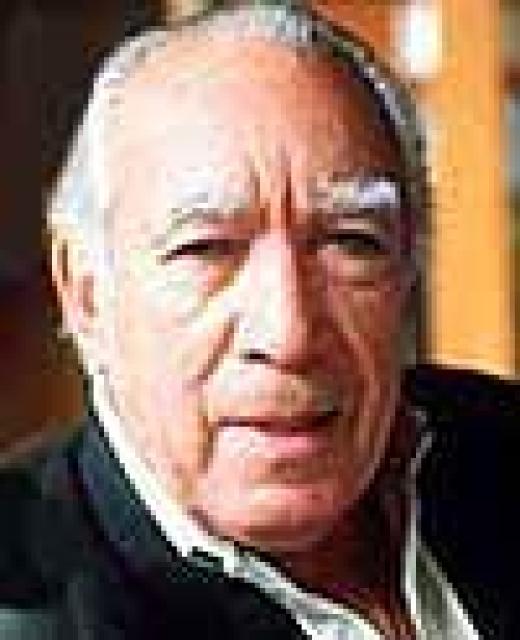
Anthony Quinn
 USA
USA- Anthony Quinn: Overcoming Challenges and Achieving Success
- Early Career and Struggles
- Recognition and International Success
- International Recognition and Later Career
Anthony Quinn: Overcoming Challenges and Achieving Success
Anthony Quinn, an actor who achieved fame and international recognition, had to wait for two decades before his career took off. Born in Mexico to an Irish-Mexican family, Quinn did not speak English until the age of 12. His accent, along with his intimidating appearance, made it difficult for him to play typical Anglo-Saxon characters. However, behind this tough exterior, Quinn was kind, generous, and loyal to his friends.
Early Career and Struggles
Quinn's journey in the film industry started promisingly when he made his debut as a gangster in "Parole" in 1936. Prior to this, he had received training at a drama school and had successful performances in plays such as "The Lower Depths" and "Clean Beds" that showcased the realities of life in a dormitory. However, he soon found himself typecast as a Native American, Spaniard, or representative of various "ethnic minorities" due to his appearance.
Recognition and International Success
Quinn's career continued to face setbacks, despite several notable performances. It was not until he played a Mexican in "The Ox-Bow Incident" in 1943, portraying a character who barely spoke English, that he caught the attention of the audience. His passionate tango scene with Rita Hayworth in "Blood and Sand" in 1941 demonstrated his ability to play romantic leads like Rudolph Valentino, but Quinn lacked the delicate features that made Valentino a heartthrob.
In 1947, disillusioned with his chances of success in Hollywood, Quinn turned to Broadway. He played Stanley Kowalski in Elia Kazan's acclaimed production of "A Streetcar Named Desire," receiving praise for his performance that rivaled Marlon Brando's portrayal. Kazan later cast Quinn in the role of Eufemio, a cunning and opportunistic character in "Viva Zapata!" (1952) which earned him an Academy Award for Best Supporting Actor. His portrayal of a ruthless Mexican bandit in "Ride, Vaquero!" in 1953 further showcased his acting prowess.
International Recognition and Later Career
In 1953, during the filming of "La Strada," Quinn met Giolanda Masina, who played one of the prostitutes. Masina introduced him to her husband, Federico Fellini, who offered Quinn the script for "La Strada" (1954). In this dark and powerful film, directed by Fellini, Quinn played the strongman Zampanò, whose journey reveals the awakening of a human being within a beast. This role brought Quinn true recognition and established him as an actor of international caliber.
Two years later, Quinn won his second Academy Award for his role as Paul Gauguin in Vincente Minnelli's "Lust for Life" (1956), a biographical film about Vincent van Gogh. Despite appearing on screen for only six minutes, Quinn's portrayal was so compelling in its celebration of life that it became synonymous with the film's title. Quinn continued to deliver remarkable performances in films such as "The Hunchback of Notre Dame" (1956) and "Requiem for a Heavyweight" (1962).
His greatest success came with the role of Zorba in Michael Cacoyannis' "Zorba the Greek" (1965). Quinn's portrayal captured the character's infinite patience, humanity, and hedonism. His performance of the Greek dance sirtaki in the film's finale showcased the essence of this life-loving character. Despite appearing in nearly forty more films after this masterpiece, Quinn could never reach the same level of success. In 1965, he divorced his wife of 27 years, Catherine, and married Italian actress Iolanda Addolori, with whom he had three sons.
Quinn briefly tried his hand at directing in 1958 with a remake of his father-in-law's film, "The Pirate," but it did not achieve the desired success. In 1973, he published his memoir, "The Original Sin." Quinn's filmography includes a wide range of roles in movies such as "The Guns of Navarone" (1961), "Lawrence of Arabia" (1962), and "The Greek Tycoon" (1978).
Anthony Quinn's journey from overcoming language barriers and typecasting to achieving recognition and international success stands as a testament to his talent, perseverance, and dedication to his craft. His powerful performances continue to inspire actors and audiences alike.


