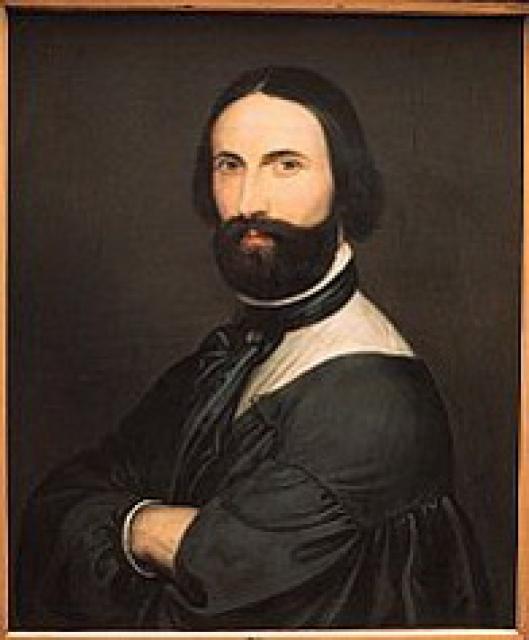
Antoine Joseph Wiertz
 Belgium
- Early Life and Education
- Journey to Paris and Artistic Influences
- Return to Belgium and Roman Prize
- Monumental Works and Religious Themes
- Personal Tragedy and Literary Contributions
- Illustration and Sculpture
- Legacy and Museum
Early Life and Education
Antoine Wiertz was a renowned Belgian painter and sculptor of the Romantic movement. Born in Dinant, Belgium, he later graduated from the Antwerp Academy of Fine Arts, where he studied under the tutelage of Mathieu-Ignace van Brée and Jacques Joseph Gerritsz.
Journey to Paris and Artistic Influences
In 1829, Wiertz moved to Paris, where he immersed himself in the art of the Louvre. He meticulously studied the works of the old masters, particularly admiring Michelangelo and Raphael.
Return to Belgium and Roman Prize
Upon returning to Belgium in 1832, Wiertz competed in the prestigious Grand Competition and won the Rome Prize. This award funded his trip to Italy, where he spent the next three years studying at the French Academy in Rome.
Monumental Works and Religious Themes
Wiertz became known for his colossal works, often depicting religious subjects. He also produced witty genre scenes and realistic portraits, such as his acclaimed "Portrait of the Artist's Mother" (1838).
Personal Tragedy and Literary Contributions
The death of his mother in 1844 deeply affected Wiertz. Relocating to Brussels, he authored polemical treatises on art, including "The Praise of Rubens" (1841) and "Treatise on the Essential Character of Flemish Painting."
Illustration and Sculpture
Wiertz also worked as an illustrator, creating portraits of Quasimodo and Esmeralda from Victor Hugo's "The Hunchback of Notre Dame." In his later years, he returned to sculpture, crafting three large-scale groups: "The Birth of the Passions," "The Struggle of Light Against Darkness," and "The Triumph of Light."
Legacy and Museum
After his death, Wiertz's studio became a state-owned museum bearing his name. It houses a collection of 42 of his paintings, showcasing the evolution of his artistic style.