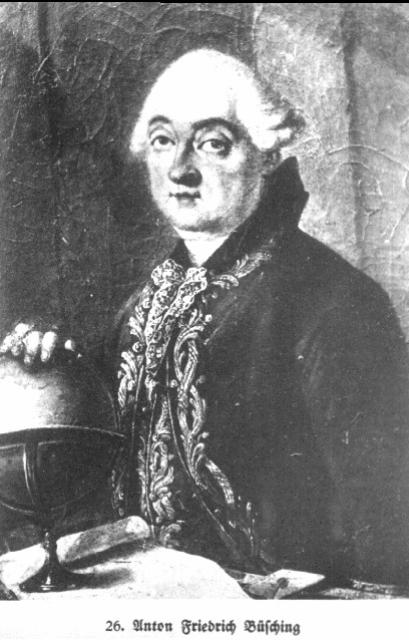
Anton Biushing
 Germany
- Anton Friedrich Büsching: A Multifaceted Scholar
- A Journey to Russia
- An Educational Center in St. Petersburg
- A Prolific Author
- Contributions as a Publisher
- Later Years
Anton Friedrich Büsching: A Multifaceted Scholar
Anton Friedrich Büsching (September 27, 1724 - May 28, 1793) was a renowned geographer, historian, statistician, bibliographer, educator, and publisher. He was born in Stadtthagen, near Hanover, into a family of lawyers. Büsching completed his studies at the University of Halle, obtaining a master's degree in theology in 1747. From 1754 to 1761, he served as a professor of philosophy at the same university and received his doctorate in theology in 1756.
A Journey to Russia
In 1750, Büsching embarked on his first trip to Russia as a tutor to the son of the Danish envoy, F.R. Dinard. He stayed in Russia until 1761, during which he served as a pastor in the Lutheran Church of St. Peter and the director of the church school, known as "Petershule," in St. Petersburg. He shared the educational and theological ideas of the German educator and theologian A.G. Franke, emphasizing the integration of teaching and upbringing. Büsching's lively communication skills and oratorical talents earned him the love and respect of his contemporaries.
An Educational Center in St. Petersburg
Under Büsching's guidance, the "School of Languages, Arts, and Sciences" in St. Petersburg became a prominent educational center. It boasted a library, a cabinet of natural curiosities, and physics and chemistry laboratories. Approximately 300 students received education at this institution. Büsching introduced the teaching of the Russian language and Orthodox religious doctrine for the first time in Russia.
A Prolific Author
Büsching authored numerous pedagogical works and textbooks on geography, history, philosophy, and religion. His geographical works gained widespread recognition, especially his "New Description of the Earth" (volumes 1-2, 1754-1759), which focused on Russia, Great Britain, Turkey, Spain, and other European and Asian countries. All volumes were translated into Russian, and the first volume, providing a general characterization of Europe and the Russian Empire, was published twice (1763 and 1766). His works covered various aspects of society, including population, political systems, culture, crafts, trade, finance, manufacturing, postal services, transportation, and more.
Contributions as a Publisher
In 1763, Büsching prepared a theoretical work titled "Guide to Thorough and Useful Knowledge of the Geographical and Political State of European States." From 1767 onwards (in Hamburg and from 1772 to 1788 in Halle), Büsching published the historical-geographical journal "Magazine of New History and Geography" in German. The journal spanned 23 volumes and contained materials on the population, governance, foreign and internal policies of European countries. It extensively presented Russian legislation of the 18th century, statistical data on the population of Russia, and the state of various economic sectors, Russian trade, the army, and the navy. Büsching was the first publisher of many works by foreign authors on Russia, including notes, diaries, travel descriptions by G.F. Basovitch, I.F. Kilburger, and others. The journal also featured works by Russian authors such as G.F. Miller, P.S. Pallas, D.K. Kantemir, P.I. Rychkov, as well as Büsching's own research on Russian history, including "A Brief History of the House of Romanov" (1767), "History of the Russian Emperor Ivan III" (1771), "History of the Family of Grand Duchess and Regent Anna and Duke Anton Ulrich of Brunswick" (1788), and biographies of A.I. Osterman, A.P. Bestuzhev-Ryumin, I.I. Lestocq, and B.K. Minikh.
Later Years
From 1773 to 1787, Büsching published the critical-bibliographical journal "Weekly Information on New Maps, Geographical, Historical, and Statistical Books and Writings" in Berlin. This journal included reviews of works on Russian history by M.M. Shcherbatov and V.N. Tatishchev, as well as F.I. Polunin and G.F. Miller's "Geographical Lexicon," N.I. Novikov's "Ancient Russian Vivilofika," and other works and maps in the Russian language. Büsching's letters and articles in the journal served as a response to events in Russia, covering topics such as the new border line between Kuban and the Sea of Azov, the renaming of the River Yaik, mining plants and serf peasants, and more.



