Antoni Wiwulski
 Lithuania
Biography of Antoni Wiwulski
Antoni Wiwulski was a Lithuanian-Polish architect and sculptor. He completed his studies at the Higher Technical School in Vienna in 1901 and then went on to study at the School of Fine Arts in Paris from 1902 to 1909.
After the death of his father in 1883, Wiwulski's mother moved with him and his siblings to Mitau. He attended a German school and later a gymnasium, before finally settling in a gymnasium in Chirow (Austria), which he graduated from in 1897.
During his time in Paris, Wiwulski had the opportunity to meet Vladislas Mickiewicz, the son of poet Adam Mickiewicz, as well as Polish pianist, composer, and political figure Ignacy Paderewski. Paderewski had the idea of creating a grand monument commemorating the 500th anniversary of the Battle of Grunwald and enlisted Wiwulski to work on it. This monument, erected in Krakow in 1910, brought Wiwulski wide recognition.
Wiwulski also completed three other significant works in Lithuania: a chapel in Siluva, the Monument of Three Crosses (1916) in Vilnius, and the unfinished Church of the Sacred Heart in Vilnius, which was the first reinforced concrete sacral building in Lithuania, started in 1913. The Three Crosses were destroyed on the orders of the Soviet authorities in 1951 but were restored in 1989. Additionally, Wiwulski's design for a wooden cross was erected on Castle Hill in Vilnius, near Gediminas Tower, on the site where the remains of those executed in 1863 uprising by the order of M.N. Muravyov were discovered in 1916.
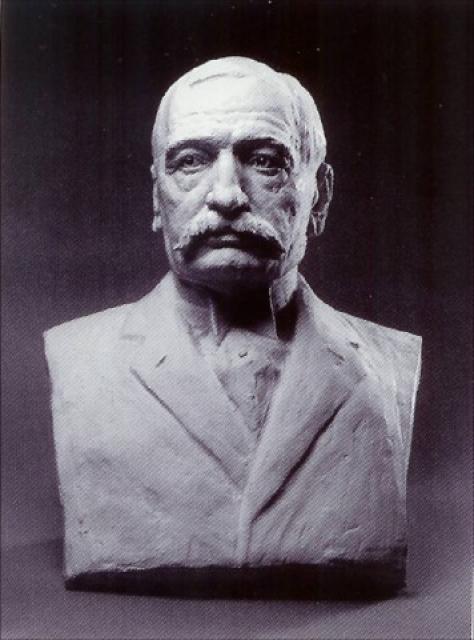
In addition to these works, Wiwulski created numerous sculptural portraits, symbolic and religious figure compositions, studios, and sketches for monuments and memorial plaques. One of them, dedicated to the memory of Tadeusz Kosciuszko, was embedded in the northern wall of the Church of St. John in 1917, on the occasion of the centenary of the national hero's death. The plaster plaque is in the form of a wide cross and depicts the leader of the 1794 uprising. The broken lower edge of the plaque symbolizes the defeat of the rebels and the shattering of unfulfilled hopes. The plaque features the uprising slogan and the dates marking the centenary of Kosciuszko's death, as well as the coats of arms of Belarus, Lithuania, and Poland.
In December 1918, Wiwulski joined the Vilnius Self-Defense Unit. While patrolling in Zarechie (now the Uzupis district), he fell ill with pneumonia and passed away on January 3, 1919. He was buried in the underground chamber of the Church of the Sacred Heart, which was designed according to his plans.
In June 1964, during the reconstruction of the unfinished yet functioning Church of the Builders' Palace, Wiwulski's remains were transferred to the Rasu Cemetery. One of the streets in Vilnius is named after him.