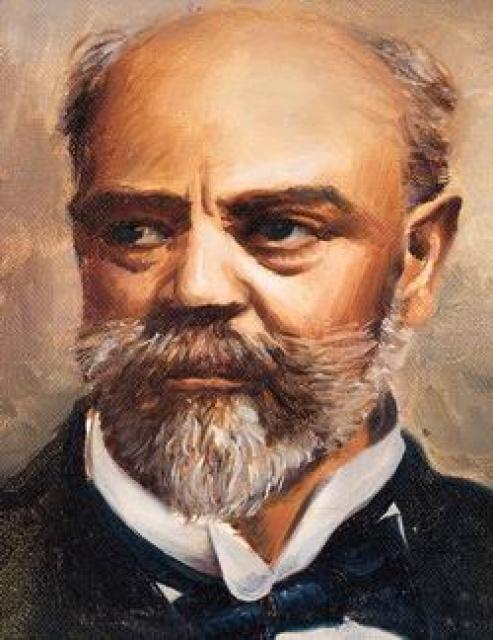
Antonin Dvorjak
 Czech
CzechAntonin Dvorak - A Biography
Antonin Dvorak, a Czech composer and conductor, is considered the greatest Czech composer alongside Bedrich Smetana. He is also known as the founder of the national compositional school. Dvorak's music is characterized by its melodic richness, structural integrity, and vibrant colors.
Early Life and Education
Antonin Dvorak was born on September 8, 1841, in the village of Nelahozeves, located on the banks of the Vltava River. At the age of six, he began attending a village school, where he learned to play the violin from the local church organist. By the age of nine, he was already performing in an amateur orchestra.
In 1857-1858, Dvorak enrolled at the Prague Organ School, where he began composing music. His early compositions were influenced by romantic composers such as Robert Schumann, Franz Liszt, and Richard Wagner.
Artistic Development
In the 1860s and 1870s, Dvorak had already established himself as a prolific composer, creating symphonies, operas, concertos, chamber instrumental and vocal compositions. He also played the viola in the Prague orchestra and became involved in the social life of Prague, forging connections with leading figures of the Czech intelligentsia.
In the 1880s, Dvorak gained international recognition as a conductor, performing his own works in England, Russia, and Germany. In 1888, he had a notable meeting with Pyotr Ilyich Tchaikovsky in Prague, which developed into a deep friendship.
In 1891, Dvorak became a professor at the Prague Conservatory, and later he was invited to the United States to serve as the director of the National Conservatory in New York. It was during his time in America that he composed one of his finest works, the final symphony titled "From the New World," which incorporates American melodies.
Dvorak returned to his homeland in 1894 and continued his composition career. Throughout his artistic journey, he explored the opera genre, creating ten operas, with the most acclaimed being "Rusalka" (1900). Additionally, he authored nine symphonies, five symphonic poems, three solo instrumental concertos (for piano, violin, cello), six overtures, as well as rhapsodies, dances, string and piano quartets, quintets, and numerous other works.
Legacy
Antonin Dvorak passed away on May 1, 1904, in Prague. His contributions to Czech music, his mastery of composition, and his ability to weave nationalistic elements have made him one of the most celebrated composers in history. His works continue to be performed and admired by musicians and audiences worldwide.