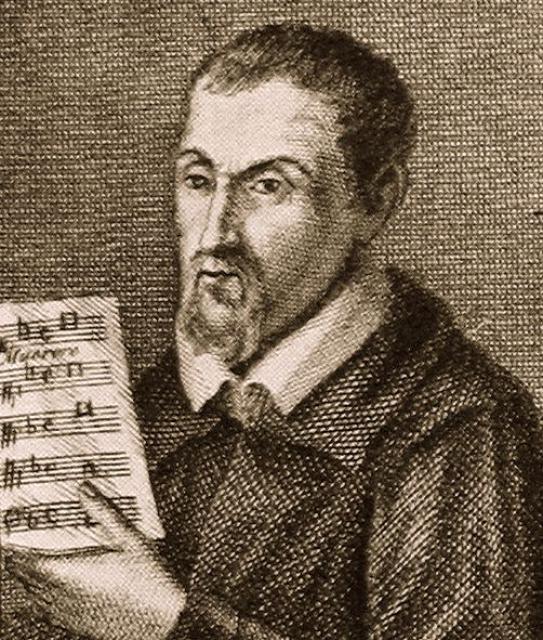
Gregorio Allegri
 Italy
ItalyBiography of Gregorio Allegri
Gregorio Allegri was an Italian priest, singer, poet, and composer, belonging to the Roman school of composers. He was born in 1582 in Rome, where his family lived, and where he later passed away. Allegri was the eldest of three sons of Milanese coachman Costantino, and his father enrolled him in the prestigious school of the church of San Luigi dei Francesi. His younger brothers Domenico and Bartolomeo also followed him to this school, and there is even a preserved contract of their enrollment.
From May 1591, Gregorio sang in the church choir and studied music under the direction of maestro di cappella Giovanni Bernardino Nanino, the younger brother of the renowned composer Giovanni Maria Nanino. In June 1596, at the age of 14, when his voice broke and turned into a beautiful high tenor, Gregorio received 1 scudo for his service in the chapel. This continued for several years. Allegri prepared to become a priest and eventually obtained benefices at the cathedral of Fermo. Here, he composed a significant number of motets and other sacred music, publishing his vocal works.
Thanks to his compositional talent, Allegri became a favorite of Pope Urban VIII, who invited him to join the Sistine Chapel choir. Gregorio remained in the chapel from December 6, 1629, until the end of his life. According to Andrea Adami, Allegri was not particularly skilled in singing, but the pope still distinguished him for his exceptional purity and kindness. Later, he received another benefice at the cathedral of Tivoli, which was not connected to Allegri's place of residence. This was a grace from the pope himself, who wanted his beloved composer to lack nothing.
In 1650, Allegri was appointed temporary maestro di cappella of the Sistine Chapel, a position he held until his death in February 1652. He was buried in the crypt of the church of Santa Maria in Vallicella, designated for Vatican singers. Again, according to Andrea Adami, the deceased did not even have a decent suit for his funeral. So many poor people constantly stood at his door waiting for alms, and there were so many prisoners he visited daily. This attested to Allegri's selflessness and immense kindness.
Among Allegri's musical works are two volumes of concertos for five voices, published in 1618 and 1619; two volumes of sacred songs for six voices, published in 1621; a symphony in four parts; five masses; two compositions based on verses from the Old Testament's Lamentations of Jeremiah; as well as numerous hymns that were not published during his lifetime. He was one of the first composers to write music for string instruments, and the German scholar and Jesuit Athanasius Kircher later provided an example of his works in his book "Musurgia universalis" (1650). Most of Allegri's published works exhibit characteristics of progressive early Baroque, especially his instrumental music.
The most famous work by Gregorio Allegri is the setting of Psalm 50, known as "Miserere (Miserere mei, Deus)." It is performed by two choirs of five and four voices, and it is considered one of the last examples of late Renaissance music, although it coincides with the beginning of the Baroque era. For many years, "Miserere" was performed in the Sistine Chapel during Holy Week, and the scores were kept in strict secrecy under the threat of excommunication for any attempt to copy them. However, in 1770, a young Wolfgang Amadeus Mozart had the chance to listen to "Miserere" twice and memorized the entire piece from the first note to the last. He then wrote it down, creating the first "pirated" copy of Allegri's composition. In 1771, this copy was purchased and published in England by the famous traveler and music historian Charles Burney, albeit without the embellishments that made the work famous.


