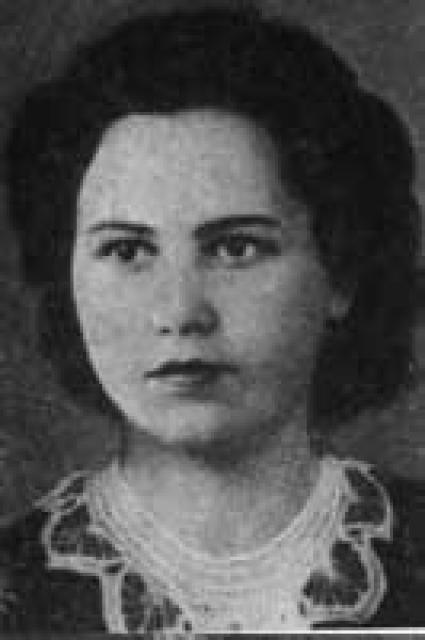
Antonina Eliseenko
 Ukraine
- Biography of Antonina Eliseenko
- Early Life and Education
- Work as a Teacher and Involvement with the "Young Guard"
- Sacrifice and Recognition
Biography of Antonina Eliseenko
Antonina Eliseenko was a participant of the underground organization "Young Guard." She joined the "Young Guard" in October 1942 and was one of the organizers of the underground group in the town of Krasnodon. Together with her fellow comrades, Tonya collected weapons in the steppes at the sites of battles, wrote, and distributed leaflets.
Early Life and Education
Antonina Eliseenko was born on February 25, 1921, in the town of Krasnodon. Her father, Zakhar Vasilievich, was a miner and a prominent activist during the first five-year plans. In 1929, Tonya started attending school. She had a great love for history and literature and often recited poems by her favorite poets, such as Alexander Pushkin, Mikhail Lermontov, and Vladimir Mayakovsky. She was also passionate about sports and participated in district and regional competitions. In 1937, Antonina Eliseenko became a member of the Leninist Komsomol, the youth organization of the Communist Party.
Work as a Teacher and Involvement with the "Young Guard"
In 1939, after completing secondary school, she successfully passed her exams and enrolled in the T.G. Shevchenko Voroshilovgrad Pedagogical Institute, majoring in philology. During the war with Finland in 1940, Tonya, along with other female students, attended courses to become medical nurses and worked in a military hospital located in the dormitory of the pedagogical institute. She took care of the wounded, read books to them, and wrote letters to their families. Her excellent work was recognized by the hospital's chief, who expressed gratitude to Antonina.
After completing her first year, Antonina Eliseenko transferred to year-long pedagogical courses organized by the regional department of public education. Upon completing her studies, she worked as a teacher in the primary grades at School No. 25 in Krasnodon. She started her first academic year during a tumultuous wartime. As a young teacher, she not only conducted lessons but also worked with students in the collective farms, helping to harvest crops.
In October 1942, Antonina Eliseenko joined the ranks of the "Young Guard" and became one of the organizers of the underground group in Krasnodon. Alongside her fellow fighters, she collected weapons in the steppes at the battlegrounds, wrote, and distributed leaflets. They even set up a radio receiver on the attic of the Sumsky house to listen to Soviet Information Bureau broadcasts. Antonina would then compile the information and create the texts for the leaflets that they reproduced.
Sacrifice and Recognition
In October 1942, Antonina was assigned to work at a hospital by the "Young Guard" headquarters. She procured medicines for the underground organization and, together with nurse N.P. Alexeenko, issued medical certificates stating illness for those who were to be sent to Germany for forced labor. However, on January 13, 1943, Antonina Eliseenko was arrested, and the following morning, she was sent to the city of Krasnodon along with a group of "Young Guard" members. After undergoing horrific torture, she was executed by the Nazis on January 16, 1943, and her body was thrown into Shaft No. 5. Antonina Zakharovna Eliseenko was buried in a mass grave alongside her fellow "Young Guard" members at the central square of Krasnodon.
Antonina Eliseenko was posthumously awarded the Order of the Patriotic War, 1st Class, and the Medal "Partisan of the Patriotic War," 1st Class.