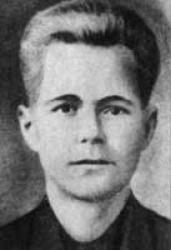
Arseniy Vorozheikin
 Russia
- Arseny Vorozheykin - Twice Hero of the Soviet Union
- Biography
- Arseny Vasilievich Vorozheykin lives in Moscow.
Arseny Vorozheykin - Twice Hero of the Soviet Union
Arseny Vasilievich Vorozheykin, born on October 28, 1912, in the village of Prokofyevo, Gorodetsky district, Nizhny Novgorod province, was a renowned Soviet aviator and twice Hero of the Soviet Union. He was awarded the Order of Lenin, four Orders of the Red Banner, Orders of Suvorov III degree, Alexander Nevsky, and the Order of the Patriotic War I degree, along with two Orders of the Red Star and six foreign orders, as well as numerous Soviet and foreign medals.
Biography
Arseny grew up in a poor peasant family. After losing his father at a young age in World War I, he experienced the hardships of being an orphan, living in poverty and hunger. However, from childhood, he aspired to overcome the difficult circumstances of his life. After completing primary school, he worked at a sawmill and served as a sailor on the Volga River. He then attended a workers' faculty, completed his mandatory military service in the cavalry, and enrolled in the Gorky Agricultural College.
His dream of becoming a pilot, which he had since childhood, led him to the Kharkov Military Flight School, which he graduated from in 1937. Even during flight school, his exceptional skills as an aerial sniper, hitting the target with ten times the required number of shots for an excellent rating, became evident. On June 22, 1939, the battles on the Khalkhin Gol River began. In an aerial battle against the Japanese, he achieved his baptism of fire, shooting down six Japanese aircraft in 30 air battles while flying the I-16. He was recommended for the title of Hero and received the Order of the Red Banner.
During a battle with a Japanese pilot, Vorozheykin suffered a severe spinal injury. The doctors' prognosis was merciless: a compression fracture of three lumbar vertebrae. However, he did not despair or give up. Instead, his thirst for victory determined his actions. Discharged early from the hospital, he "lost" his medical certificate for being unfit for flight duty and returned to his unit. And once again, he took to the sky.
Vorozheykin's talent fully revealed itself during the Great Patriotic War. Before the war, he had participated in the Soviet-Finnish War. After its conclusion in 1940, he was assigned to the Military Aviation Academy, which he successfully completed in September 1942.
Arseny Vasilievich arrived at the Eastern Front of the Great Patriotic War as an experienced pilot, with over 100 combat flights and academic education. In September 1942, Vorozheykin was sent to the 728th Fighter Aviation Regiment on the Kalinin Front. There, near Toropets, flying the I-16, he conducted dozens of combat flights. His first victory in the Battle of Kursk was achieved while flying the Yak-7B. Vorozheykin shot down a new three-cannon German fighter, the Me-109 G-2. In the next battle near Prokhorovka, he shot down two Ju-87s - he tore open the belly of the first one and unexpectedly struck the second one from above out of the clouds.
In one of the battles, while saving his wingman Dmitry Anin in a damaged aircraft, Vorozheykin distracted the attention of four Messerschmitts onto himself. One against four! Later, in his book "Over the Kursk Bulge," Vorozheykin would write: "The plane seemed to dissolve in me. It became an extension of my hands, feet, and thoughts. The success of a short skirmish is determined in a moment. But such a moment, when guns and machine guns are targeting the back of your head, freezes your blood in your veins, and seconds seem like eternity." Vorozheykin won this eternity, shooting down two Me-109s and damaging a third. The fourth one hesitated and turned back. A few days later, a group of our pilots attacked a large group of He-111s and shot down four bombers. Two of them were credited to Vorozheykin. In one of the battles in October 1943, he again shot down two Ju-87s in one attack: he hit the first bomber from below, while the damaged aircraft veered off course and crashed into its neighbor.
During his frontline career, Vorozheykin achieved victories over Messerschmitts, Focke-Wulfs, Junkers, and Heinkels, always combining calculated strategy with daring bravery. He never underestimated his opponents, saying to the pilots of his squadron, "In war, you must know the strengths and weaknesses of the enemy. Then it is easier to fight."
In early 1944, his regiment was re-equipped with Yak-9s. Vorozheykin became the first to shoot down a Focke-Wulf-190 on this fighter. In war, anything can happen. He often had to come to the aid of his comrades, endure his own plane catching fire, experiencing engine failure, and making emergency landings. In March 1944, after shooting down a Fascist reconnaissance aircraft, an Hs-123, he himself was shot down. Miraculously, he managed to land the plane in a clearing in the enemy-occupied territory. His friends rushed to help, managed to land a Po-2 on a clearing, and evacuated their commander under the cover of two Yak fighters, piloted by Sergey Lazarev and Alexey Kovalenko.
During a combat mission in the Ternopil region, flying a new Yak-9T with a powerful 37-mm cannon, he noticed a three-engine Ju-52 heading towards Soviet troops. The "Junker" behaved peacefully, with its machine gun turrets raised. Vorozheykin and his wingman approached the transport aircraft, even seeing the pilots raising their hands and many faces in the windows. Suddenly, more than a dozen tracer rounds were fired at them from the side of the "Junker": the gunners and passengers, having lulled his vigilance, opened fire. Reacting instantly, Vorozheykin "dived" his aircraft, executed a combat turn, and with a long burst from behind, literally tore apart the enemy. Later, on the same mission, he shot down two more Ju-52s and a Ju-88! If we count the number of engines destroyed in this battle, it was the most "productive" mission in the history of the Soviet Air Force: four shot-down aircraft with a total of 11 engines.
Arseny Vasilievich Vorozheykin received his first Gold Star of the Hero of the Soviet Union on February 4, 1944, when the number of enemy aircraft shot down by him reached 46. On August 19, 1944, he was awarded the title of Hero of the Soviet Union for the second time.
In July 1944, Arseny Vasilievich was appointed commander of the 32nd Fighter Aviation Regiment. He was later transferred to the position of Senior Inspector-Pilot of the Main Directorate of Frontline Aviation.
In April 1945, over Berlin, in a pair with Major Treschev, he caught up with an Arado jet fighter-bomber. The latest innovation in Hitler's military technology was shot down and disappeared into the smoke.
His combat comrades and friends called Arseny Vorozheykin the "General of the Sky." Yes, indeed, a general of the sky: he led pilots into battle, taught them all the intricacies of aerial combat, the art of surprise attacks, and the ability to win. Throughout his flying career, Vorozheykin flew on nearly 400 combat missions, shot down 54 enemy aircraft personally (including 6 during the Khalkhin Gol), and 14 in a group. He was wounded three times.
After the war, Arseny Vasilievich commanded an aviation regiment, a division, and served as Deputy Commander of the Black Sea Fleet Air Defense. In 1952, he graduated from the General Staff Academy. He continued flying until 1957 and mastered many types of jet aircraft, including the La-15, Yak-15, Yak-17, MiG-15, and MiG-17. He retired as a Major General.
Currently, Arseny Vasilievich is engaged in literary activities. He is a member of the Writers' Union and the author of 12 books published in our country and abroad. Among them are "Fighter Aircraft," "Over the Kursk Bulge," "An Ordinary Aviation Soldier," and others.