Apostolo Zeno
 Italy
ItalyBiography of Apostolo Zeno
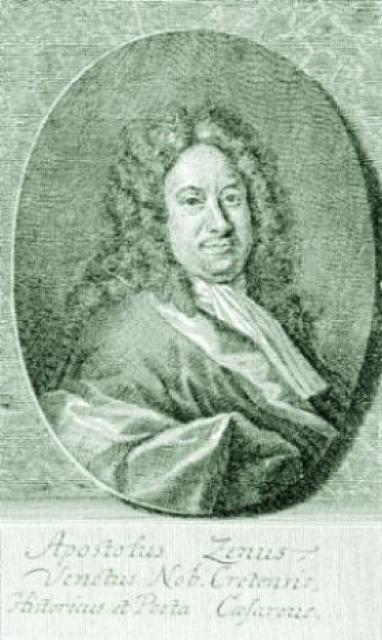
Apostolo Zeno, a Venetian poet, librettist, journalist, and writer, was born in Venice to Pietro Zeno, a physician, and Caterina Sevasto, a Greek woman from an influential Greek clan. In 1691, he participated in the creation of the "Accademia degli Animosi." In 1695, Zeno wrote his first libretto, "Gli inganni felici," which surprisingly received warm recognition and established him as a talented writer.
From 1705, Zeno collaborated with Pietro Pariati, with Pariati focusing on the overall composition of the libretto while Zeno worked on specific theatrical scenes. Later, Zeno ventured into a new role as a literary journalist for the "Galleria di Minerva." However, he soon grew tired of journalism, realizing that his articles could not have the impact he desired on the world.
In 1710, together with Scipione Maffei, Antonio Vallisneri, and his brother Pier Caterino Zeno, Apostolo created the "Giornale de' letterati d'Italia" (Journal of Italian Literature). The journal aimed to satisfy the intellectual and aesthetic needs of its fellow citizens. Renowned Italians such as Eustachio Manfredi, Ludovico Antonio Muratori, Giovanni Battista Morgagni, Giovan Battista Vico, and Bernardino Ramazzini joined the journal within three months.
Throughout his career, Zeno wrote librettos for 36 operas based on historical and mythological themes. Some of his notable works include "Gli inganni felici," "Faramondo," "Lucio Vero," "Merope," "Alessandro Severo," "Griselda," "Teuzzone," and "Semiramide." He also wrote 17 successful oratorios. Zeno dedicated significant time to literature, particularly his "Dissertazioni vossiane," which involved commentaries and corrections to "De historicis latinis."
Zeno's popularity as a writer can be attributed to his ability to meet the demands of his time. Italian readers no longer found unrealistic and exaggerated plots of ordinary melodramas satisfying. They craved more complex yet believable stories. Zeno was one of the first writers to make melodrama a stricter and more logical genre, and his ideas were later fully developed by Metastasio.
In 1718, Zeno, already known for his poetic achievements, was called to the imperial court in Vienna, where his brother Pier took over the journal's leadership. Zeno remained in Vienna until 1729 when he was succeeded by Pietro Metastasio as court poet. Upon returning to Venice, Zeno dedicated himself to the collection of coins and furthering his already substantial knowledge. He pursued these fascinating endeavors until his death.